
Zoomed Vinay Special · First-person editorial
Yoga Was Never Just Stretching. The Word Means "to Yoke", and What It Yokes Is Your Attention. Here Is What the Evidence Shows.
You have probably done a yoga class. Almost nobody tells you what the word actually means, what a small stone seal from around 2500 BCE does and does not prove, how one teacher in the Mysore Palace taught the students behind many of the styles practised around the world today, or why one afternoon in Chicago in 1893 is the date yoga's Western story starts. Told from zero, and graded: what is true, what is unsupported as stated, and what is a misunderstanding.
The point of view
Chicago, 11 September 1893. An unknown Hindu monk says five words, "Sisters and brothers of America", and thousands of delegates are on their feet for two minutes before he has even finished his greeting. His name is Swami Vivekananda, and yoga's story in the West starts there. But that is the end of this story, not the beginning. The beginning is a word, and the word is not "stretching". It means to yoke, to join, and what it joins is your attention. Then a seated figure on a stone seal, one teacher in a Mysore palace, and four students. And one popular claim I wanted to be true, which the evidence does not support as stated. Let's go from zero.
Chicago, 11 September 1893
Let me take you to Chicago. To be precise, 11 September 1893.
The World's Parliament of Religions. Thousands of delegates. And among the speakers, a previously unknown Hindu monk. His name is Swami Vivekananda.
He opens his address with five words: "Sisters and brothers of America."
That's it. Five words. And the delegates are on their feet. A standing ovation, two minutes long, before he has even finished his greeting.
Think about that for a second. Two minutes is a long time. Count it out in your head sometime. Thousands of people on their feet, for a previously unknown monk, for a greeting.
He does not go home after that. Over the following months and years he stays in the United States, lecturing widely, and he introduces Western audiences, for the first time in an organised, public, widely reported way, to yoga and to Vedanta philosophy.
This is not a legend. It is a named person, a named event, a named date. Heavily documented. If you want a starting gun for yoga in the West, this is it.
But listen carefully, because here is the twist. That afternoon in Chicago is the end of this story, not the beginning.
The beginning is a word.
The words you need, in plain language
Before we go anywhere, four words. If you get these four, everything after this is easy.
Yoga. It comes from a Sanskrit root that means "to yoke" or "to join". Picture two oxen yoked together so they pull in the same direction. Same idea. Now, here is the question. What is being joined? Not your hamstrings and a stretch. Your attention. At its core, yoga is a discipline for taking a scattered, wandering mind and bringing it into one steady, focused state.
Asana. A physical posture. One tool among several for getting there. Not the destination.
Turiya. The tradition names three ordinary states of mind: waking, dreaming, and deep, dreamless sleep. Turiya is the fourth, beyond those three. Pure, still awareness, without the usual mental noise of the other three.
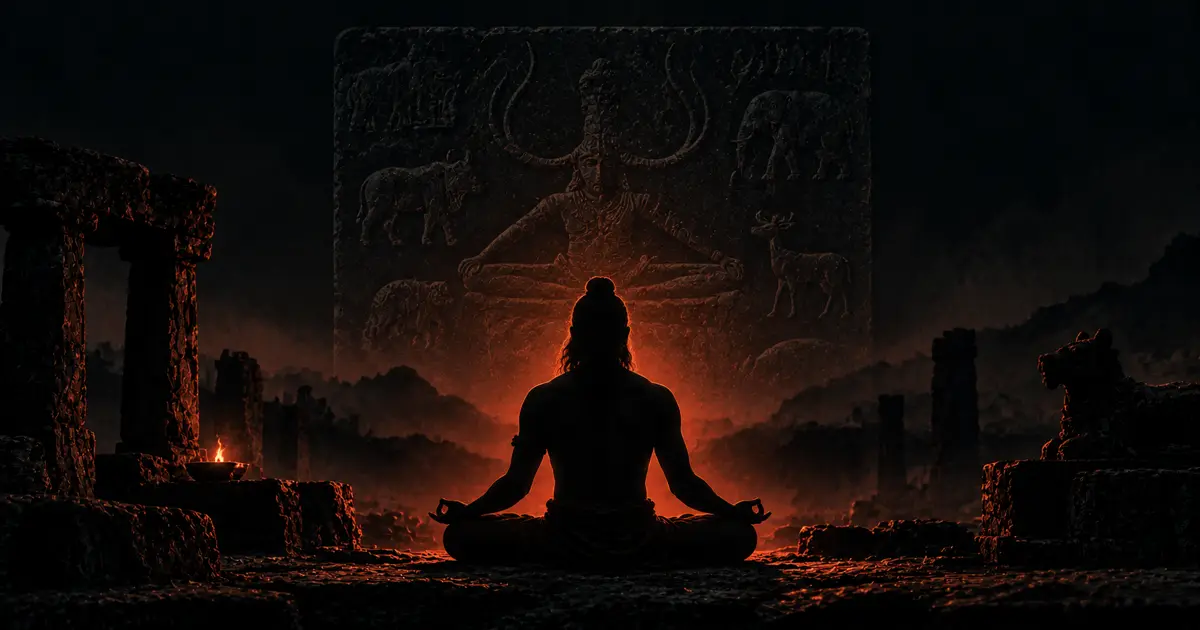
The Pashupati seal. A small carved seal from Mohenjo-daro, in the Indus Valley Civilization, usually dated to around 2500 BCE. It shows a figure seated cross-legged. The name "Pashupati" comes from one interpretation: that the figure is an early form of a deity later associated with Shiva. One interpretation. Hold on to that word; we will need it.
Three claims, graded before we start
I am going to tell you the result first, so you can watch me earn it.
- Yoga is a discipline of attention, not primarily exercise; a cross-legged seated figure is pictured on a seal from around 2500 BCE; almost every modern yoga style traces, by a documented teacher–student chain, to Krishnamacharya at the Mysore Palace; and yoga's Western introduction has a date, 11 September 1893. True, and I will set out each piece below.
- "Yoga is 4,500 years old, proven, end of story." Unsupported as stated. A seated figure is a plausible visual precedent for a posture. It is not proof of a philosophical system. The evidence for that system comes later, and it is textual.
- "Yoga means exercise poses." A misunderstanding. Poses are a real, valid part of it. But historically they are the smallest part, and if you start there you get the whole thing backwards.
Not just poses: the misunderstanding first
Let me ask you something. When you hear "yoga", what do you see?
A mat. A class. Stretchy pants. Someone saying "breathe into it".
If that is your only picture of yoga, nobody can blame you for thinking "yoga" means "exercise poses". And it is not wrong, exactly. Poses are a real, valid part of it.
But they are the smallest part, historically speaking. Starting with the poses is like judging a cricket team by its warm-up stretches. The stretches are real. They matter. They are not the match.
The word means yoking. And the thing being yoked is attention.
Four states of mind, and the fourth one
Now here is something that is useful in ordinary life, not just interesting as philosophy. Stay with me.
The tradition says your mind moves through distinct states.
Waking. You are alert, and aware of the world outside you. Right now, reading this.
Dreaming. Your mind is active, busy even, but cut off from the outside world.
Deep, dreamless sleep. Here awareness itself seems to switch off.
Three states. Every one of us knows all three. Nobody has to believe anything to recognise them.
And then the tradition names a fourth. Beyond those three. Turiya. Pure, still awareness, without the noise.
So what is meditation, in this framework? Here is the part most people get wrong. It is not "trying to think about nothing". Think about it: the moment you try to think about nothing, you are thinking about trying. Meditation here means training your attention toward that fourth, quieter state, on purpose, while you are awake, instead of only stumbling into brief flashes of it by accident.
That is the claim the tradition makes about the mind. I am not telling you what it will do for your health; that is not what this piece is about, and it is not what the record I read says. I am telling you what the word was pointing at all along.
Clue 1: a seated figure on a stone seal, around 2500 BCE
Now the evidence gets physical. And this is the place where I have to be most careful with you, because this is the place where it is easiest to claim too much.
In the ruins of Mohenjo-daro, archaeologists found the seal. On it, a figure, seated cross-legged. A pose that looks strikingly similar to a classic cross-legged meditation posture that people still sit in today.
Usually dated to around 2500 BCE. Roughly four and a half thousand years ago.
I will be honest with you. When I started on this, I wanted the story to be simple. Seal, yoga, 4,500 years, done. I wanted this to be true too. So here is what the evidence actually says.
What it does show, and it is genuinely striking: it is reasonable evidence that something resembling a meditative seated posture existed in that region thousands of years before any surviving written yoga text describes one formally.
What it does not show: a picture of someone sitting a certain way is not, by itself, proof of a fully developed philosophical system, with named goals and named techniques. That is a separate layer of evidence. It is later. And it is mostly in texts.
Try a thought experiment. Imagine someone four thousand years from now digs up a photograph of a person sitting cross-legged on a floor. Can they tell from the photograph alone whether that person was meditating, eating lunch, or listening to a story? They cannot. They can say the posture existed. They cannot read the mind of the person in it.
That is exactly where the seal stands. And remember the word I asked you to hold on to: "Pashupati" is one interpretation. What the figure meant to the people who carved it, nobody can read off the stone.
Clue 2: one teacher in Mysore, four students, and the yoga the world practises
This part of the story is much more recent, and much more precisely documented. And honestly, it is one of the most remarkable stories of a tradition being handed on that I have come across in this whole series.
Early-to-mid 20th century. A teacher named Tirumalai Krishnamacharya is teaching yoga at a school inside the Mysore Palace, in South India.
Now watch who his students are. Four names.
One. His brother-in-law, B.K.S. Iyengar. Iyengar went on to found Iyengar Yoga, known worldwide for its precision and its use of props.
Two. K. Pattabhi Jois. He developed Ashtanga Vinyasa Yoga, the dynamic, flowing style behind most of the modern "power yoga" and vinyasa classes.
Three. Indra Devi. One of the first Western women to study yoga seriously in India. She later taught yoga to Hollywood celebrities, and helped popularise it across the United States and Latin America.
Four. Krishnamacharya's own son, T.K.V. Desikachar, who learned from his father later, in Madras (now Chennai). He developed a more individualised, therapeutic approach to teaching.
One teacher. Four students. Now listen carefully, because here is why that matters.
If you have taken a yoga class anywhere in the world in the last several decades, there is a very real chance that the style you practised traces back, through a documented teacher–student chain, to one man teaching in a palace in Mysore.
That is not vague cultural pride. I am not saying "we did everything first". I am saying something smaller and much stronger: here is a specific, named lineage, and you can trace it generation by generation. Teacher, student, student's style, the class down your road.
Think about the class down your road for a second. The teacher there learned from someone, who learned from someone. Follow that chain back far enough, and there is a very real chance it ends in one palace in South India.
Clue 3: Chicago, the starting gun
Now we can come back to where we started.
If you want one specific, dated moment to point to for yoga's formal introduction to the West, it is the one I opened with. Chicago. 11 September 1893. Vivekananda. "Sisters and brothers of America."
Not some vague line like "yoga gradually became popular in the West". It has an actual starting gun, and the starting gun has a date.
The other road: east, to China
And here is something most people never hear.
Separately, and earlier, Buddhist monks carried meditative practices out of India into China. One of them is remembered by the name Bodhidharma. In China those practices influenced Chan Buddhism, which later became Zen Buddhism in Japan.
So think about the map for a moment. That is a real, traceable route of a meditative tradition moving eastward out of India, centuries before that afternoon in Chicago sent a related tradition west.
Two roads out of India, centuries apart, in two directions.
Now let me give you the sceptic's side, honestly
A fair file has to argue against itself. So here is the strongest case on the other side.
The sceptic's best point is one I have already granted you: the seal shows a posture, not a system, and the earliest formal yoga texts come much later. Correct. I agree.
The sceptic can add something else. Modern postural yoga, the kind taught in most classes today, is a 20th-century development, through Krishnamacharya's school.
Now here is the twist. That is exactly the lineage this file documents. So that point does not hurt the file. It is a point for it, not against it.
And what can the sceptic not move? The date in Chicago. And the named chain from Mysore.
On the record: the whole file in one place
If you read nothing else twice, read this. Every claim, in exactly one column.
True. - Yoga is a discipline of attention, with posture as one tool; the word means yoking, and what it yokes is attention. - A cross-legged seated figure is carved on a seal from Mohenjo-daro, usually dated to around 2500 BCE. - B.K.S. Iyengar, K. Pattabhi Jois, Indra Devi and T.K.V. Desikachar all studied under Krishnamacharya, who taught at a school inside the Mysore Palace. - Almost every modern yoga style traces, by a documented teacher–student chain, to Krishnamacharya at the Mysore Palace. - Vivekananda introduced yoga to the West at Chicago on 11 September 1893.
Unsupported as stated. - "Yoga is 4,500 years old, proven, end of story." The seal is a plausible visual precedent for a posture, not proof of a system.
A misunderstanding. - "Yoga means exercise poses." A real, valid part of it, and historically the smallest; the record corrects the rest.
What I could not prove
Two things. I am telling you plainly, because a file that hides its gaps is not worth reading.
- What the seated figure on the seal meant to the people who carved it. "Pashupati" is one interpretation. All I claim is a plausible visual precedent for a posture.
- A continuous line from the seal to the textual tradition. These are two separate layers of evidence, and I keep them separate.
Step back for a minute
What follows is my own view.
It would have been very easy to write a punchier version of this. One line: "Yoga is 4,500 years old, proven, end of story." It would travel well. People would share it.
But that is not what the evidence supports. So I did not write it.
Here is what I can say honestly, and if you ask me, it is a better story. A plausible visual precedent for a meditative seated posture goes back roughly four and a half thousand years. The philosophical tradition built around stilling the mind is real, and it is well documented in its own right. And the modern global spread of yoga is extremely well traced: a specific teacher who taught in a palace in Mysore, four specific students, and a specific afternoon in Chicago in 1893.
That is a remarkable, well-evidenced story on its own terms. It does not need an exaggerated headline. Real pride does not need inflating. It needs the evidence, and here the evidence is enough.
The verdict
Yoga was never just stretching. The word means yoking, and what it yokes is attention.
That yoga is a discipline of attention with posture as one tool; that a cross-legged figure is carved on a seal from around 2500 BCE; that Iyengar, Jois, Indra Devi and Desikachar all studied under Krishnamacharya; and that Vivekananda introduced yoga to the West at Chicago on 11 September 1893: true.
That yoga is "4,500 years old, proven": unsupported as stated. The seal is a plausible precedent for a posture, not proof of a system.
That yoga means exercise poses: a misunderstanding that the record corrects.
What would change my mind? A text or an inscription from the Indus period that names the practice. Or a break in the documented Mysore lineage. Neither is in the record I read.
So don't take my word for it. Go and look at the seal yourself, and follow the chain from Mysore yourself. That is why this stays here, on the record.
One palace, one teacher, four students, one afternoon in Chicago. And a word that means to join.
Corrections
2 November 2026. An earlier version of this file said in its verdict that B.K.S. Iyengar, K. Pattabhi Jois, Indra Devi and T.K.V. Desikachar all studied under Krishnamacharya at the Mysore Palace. That is not right for Desikachar. Krishnamacharya settled in Madras (now Chennai) after 1952, and Desikachar studied under him there from 1960. The verdict now says only that all four studied under Krishnamacharya.
Source Library
Pashupati seal
National Museum, Government of India
Original citation linked to this published story. Its downloadable Source record is still completing editorial publication.
John Henry Barrows (ed.), The World's Parliament of Religions, vol. 1 (Chicago: Parliament Publishing Company, 1893), ch. III, pp. 101–102, primary record of the proceedings
archive.org
Original citation linked to this published story. Its downloadable Source record is still completing editorial publication.
History of Iyengar Yoga
International Iyengar Yoga Association
Original citation linked to this published story. Its downloadable Source record is still completing editorial publication.
Iyengar Yoga National Association of the United States, "B.K.S. Iyengar", institutional biography
iynaus.org
Original citation linked to this published story. Its downloadable Source record is still completing editorial publication.
Encyclopaedia Britannica, "B.K.S. Iyengar" (Lawrence Kowalski and Britannica Editors), encyclopedia biography
britannica.com
Original citation linked to this published story. Its downloadable Source record is still completing editorial publication.
Encyclopaedia Britannica, "Vivekananda" (Sohini Dasgupta and Britannica Editors), encyclopedia biography
britannica.com
Original citation linked to this published story. Its downloadable Source record is still completing editorial publication.