
Zoomed Vinay Special · First-person editorial
What OM Actually Means: Four States of Consciousness in One Breath. And the 1965 "Hum" That Is a Parallel, Not Proof
It is the most recognisable sound in Indian spirituality, and most people who chant it have never been told what it is for. The twelve verses of the Mandukya Upanishad say it: A for waking, U for dreaming, M for deep sleep, and the silence after it for the fourth. Then the hiss two American scientists could not get rid of in 1965, and exactly what that resemblance is and is not. One claim is true, one is unsupported, one is an open question, and I tell you which is which, one layer at a time.
The point of view
Let's go to Bell Labs. The year is 1965. Two American scientists, Arno Penzias and Robert Wilson, are trying to kill an annoying hiss coming out of a large antenna. Nothing works. That hiss turns out to be leftover radiation from the birth of the universe, a faint, constant background in every direction, and in 1978 it wins them the Nobel Prize. Now hold that picture, a constant hum beneath everything, and go back more than a thousand years, to a text of just twelve verses that built a whole practice around one sound. Let me ask you something: you have chanted OM, heard it, maybe seen it on a T-shirt. Has anyone ever told you what it is actually for? It is a map. I will walk you through it, and then I will tell you plainly what the 1965 discovery does and does not say about OM. It is a parallel, not a proof, and the truth is beautiful enough as it is.
Bell Labs, 1965: a hiss that would not go away
Let's go to Bell Labs. The year is 1965.
Two American scientists, Arno Penzias and Robert Wilson, have a problem. There is a hiss in their large antenna. A constant, annoying background noise. They try to get rid of it. They cannot, no matter what they try.
Think about it. You have a radio, it crackles, you fiddle with the dial, you check the wires, you clean everything. And the crackle is still there. Day and night. Whichever way you point it.
That "noise" turns out to be one of the most important discoveries in the history of physics. It is leftover background radiation from the birth of the universe itself. A faint, constant hum, still detectable today, in every direction, everywhere in space. It is called the cosmic microwave background. And in 1978, Penzias and Wilson won the Nobel Prize in Physics for it.
Now hold that image. A constant hum beneath everything.
And go back a thousand years and more, to a text of twelve verses that built an entire practice around a single sound. This file explains that text properly. And then, before we finish, I will tell you exactly what that 1965 hiss is, and what it is not, when it comes to OM. Because it is very easy to say more about that hiss than anyone can prove. I am not going to.
First, the words you need
Four names. Learn them once, and the rest of this file is easy.
Mandukya Upanishad. A text of the Atharva Veda, only twelve verses long. Twelve. The tradition holds that these twelve verses contain the essential core of Vedanta, distilled to its smallest form.
Gaudapada Karika. A later commentary by a scholar named Gaudapada, which expands and explains those twelve verses in much greater depth.
Vaishvanara, Taijasa, Prajna, Turiya. The four states the text names: waking, dreaming, deep dreamless sleep, and "the fourth", pure, silent awareness underneath the other three.
Shankha. The conch shell. Along with temple bells, it shares the same belief: that a sustained, resonant tone carries real significance.
Three claims, three grades
Here is what this file tests. I grade each one now, so you know where we are going.
- OM is a structured map of four states of consciousness, laid out in the twelve verses of the Mandukya Upanishad, with each sound of the syllable mapped to a state. True. That is literally what the text says it is for, and I set it out below, idea by idea.
- Ancient India predicted the cosmic microwave background, or there is a proven link between OM and the physics. Unsupported. Nobody has shown one, and this file does not pretend otherwise.
- OM is connected to omega, omni, "Amen"/"Amin" or Celtic symbols. An open question, not a connection. Surface-level sound resemblances, with no historical-linguistic work behind them.
One true, one unsupported, one open. Remember that score. Now let's go inside the first one.
OM is not just a sound. It is a map.
Let me ask you something. You have heard "OM" chanted. Hummed. Printed on a T-shirt, painted on a wall, stuck on a car. How many times in your life has someone sat you down and told you what it is for?
Here is what almost nobody tells you. It is not a word. And it is not decoration.
It is a compressed, structured model of your entire inner life. Your waking mind. Your dreaming mind. Your sleeping mind. And something beyond all three. Built into a single two-second sound.
I know how that sounds. Like a poster line. It is not a poetic exaggeration. That is literally what the oldest text describing it says it is for.
The four states, named precisely
Listen carefully, because this is the part everything else stands on.
State one: Vaishvanara, the waking state. This is you, right now, reading this. Aware of the outside world through your five senses. Your mind pointed outward, at things that exist whether you are thinking about them or not. The chair. The phone. The noise outside.
State two: Taijasa, the dreaming state. This is your mind at night. Still active, still generating experience, but now turned inward. Building an entire world out of nothing but your own mind, with no outside senses feeding it. Think about last night's dream. Who built those streets? Who cast those people? You did. With your eyes closed.
State three: Prajna, deep, dreamless sleep. This is the state where even that inward dream-world switches off. You are not aware of anything. Not the outside world, not an inner dream. But here is the thing. You are not gone either. Because you wake up rested, not erased. Something continued through that gap, even though nothing was being experienced.
Think about it. When you wake up from a good, deep sleep and say "I slept well", who is saying that? Who was there to know it?
State four: Turiya, "the fourth". This is the one most people never hear about. Because it is not a state you fall into automatically, the way you fall into sleep. It is a state of pure, silent awareness. Awareness itself, with no object, no dream, no outside world, and no blankness either. The text describes it as the background that all three other states actually rest on.
The comparison that helps me is a cinema screen. The movie is what you watch: the hero, the songs, the fight. But the screen is what the movie is projected onto. It is there whether or not a movie happens to be playing. Waking, dreaming and deep sleep are the movies. Turiya is the screen.
Say it slowly: why OM is built the way it is
Now do something for me. Right now, out loud. Say "OM" slowly. And pay attention to what your mouth actually does.
"A" — an open "ah" sound, made at the very back of your throat. Mapped directly onto Vaishvanara, the waking state.
"U" — a rounding "oo" sound, as your lips curl inward. Mapped onto Taijasa, the dreaming state.
"M" — a closed hum, made entirely behind sealed lips. Mapped onto Prajna, deep sleep.
Silence — the quiet after the hum fades out. Mapped onto Turiya, the fourth state, the awareness underneath all three of the others.
Did you catch it? Open, then rounding, then closed, then nothing. Outward, then inward, then shut, then the stillness after.
So when you chant "OM" correctly, and then let the silence afterwards actually register instead of rushing to the next thing, you are not just making a sound. You are moving your attention, step by step, through waking, into dreaming, into deep sleep, and finally into the silence that the tradition says sits underneath all three, every single day of your life, whether you ever notice it or not.
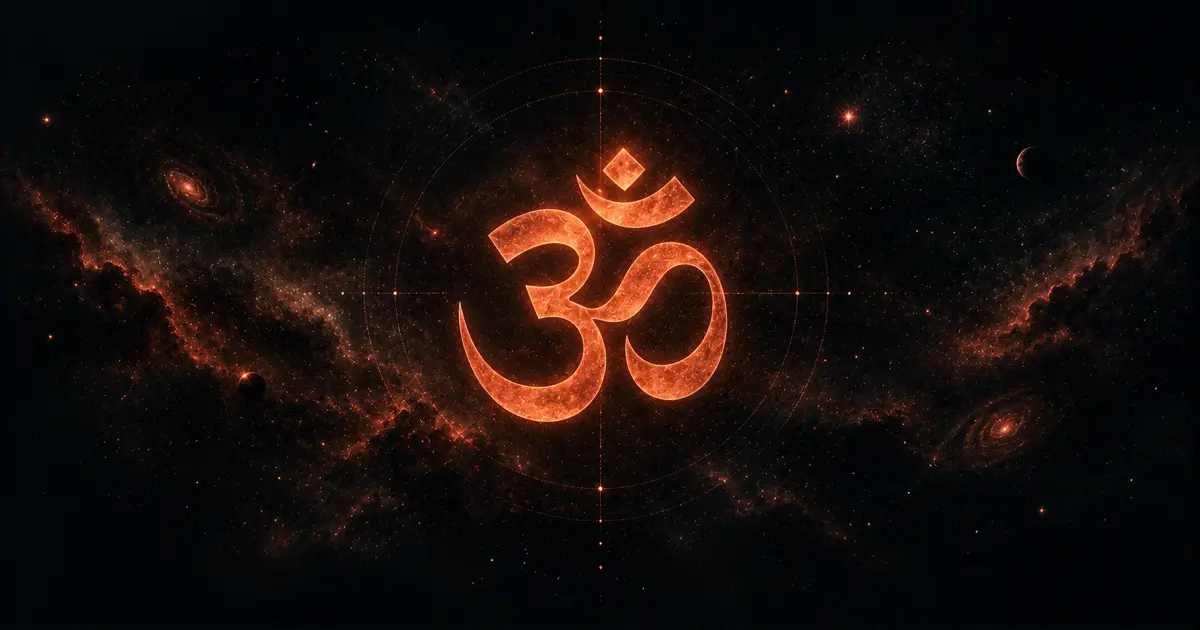
That is the entire, literal, stated purpose of the syllable. A four-part diagram of consciousness, small enough to say in one breath.
Here is the twist, if you like. We spend money on apps that tell us to "be mindful". The map for this one fits in twelve verses.
Different shapes, the same sound
Now look at the symbol. The written OM looks different in every Indian script. Devanagari's OM looks nothing like Tamil's. Tamil's looks nothing like Gujarati's.
You might think that is a complication. I see it the other way round, as useful evidence. As this file reads it, the sound and the four-part idea behind it are the stable core of the tradition, and the visual symbol is regional packaging that kept changing. It is like a song that one region writes in one alphabet and another region in a different one, while everyone sings the same tune. The idea travelled further, and stayed more intact, than any single way of drawing it.
And sound and resonance show up elsewhere in the same tradition too. The temple bell. The shankha. Both lean on the same underlying belief: that a sustained, resonant tone carries real significance, not just pleasant background noise.
The 1965 hum: I wanted this to be true too
Now we come back to Bell Labs. And this is where I have to be straight with you.
Maybe you have heard it put like this: ancient India predicted this discovery, and there is a proven link between OM and the physics.
I wanted this to be true too. Here is what the evidence actually says.
Let me tell you exactly what this file is claiming about Penzias and Wilson, and what it is not.
It is not claiming that ancient India predicted this discovery.
It is not claiming there is a proven link between the two ideas. Nobody has shown one.
What it does say, directly, is this. It is a real, striking fact that a spiritual tradition built an entire practice around the idea of a constant, foundational hum underlying all of existence. And that centuries later, physicists independently found that the universe really does have a constant background in every direction, which we describe as a "hum", measurable and physical, though strictly it is radiation, not sound. Two separate traditions, one ancient and spiritual, one modern and scientific. Both arrived at the picture of "a constant hum beneath everything".
That is a parallel. Not a proof. Not a prophecy. A parallel.
Sit with that. It is worth sitting with, exactly as it is, without needing to inflate it into more than it is. And honestly? I think it is more beautiful left alone. Two very different ways of looking, centuries apart, ending on a similar picture. You do not need to inflate it into a miracle for it to move you.
Now the other side, honestly
The sceptic has three points. Let me give them to you in full, because he is right on all three.
One. The cosmic microwave background is radiation, not sound.
Two. "Hum" is a metaphor on one side and a measurement on the other.
Three. A resemblance between two ideas is not a connection between them.
This file says exactly the same thing. I am not arguing with him.
He is also right that the omega, omni and "Amen" comparisons have no linguistic work behind them. This file says that too.
So what is left, after the sceptic has had his full say? The text itself. Twelve verses that say what OM is for, in their own words. That part nobody needs to stretch.
On the record: every claim in one place
Here is the whole file, sorted.
True - The Mandukya Upanishad, twelve verses of the Atharva Veda, lays out four states, Vaishvanara, Taijasa, Prajna and Turiya, and maps the syllable onto them: A for waking, U for dreaming, M for deep sleep, and the silence after for the fourth. The Gaudapada Karika expands it. - Penzias and Wilson found the cosmic microwave background at Bell Labs in 1965 and won the Nobel Prize in Physics for it in 1978.
Unsupported - That ancient India predicted the cosmic microwave background, or that a link between OM and the physics is proven. The parallel is striking, and it is stated as a parallel.
An open question, not a connection - That OM connects to omega, omni, "Amen"/"Amin" or Celtic symbols.
What I could not prove
Two things. I will say them as plainly as the true parts.
- Any link between the Upanishad and the physics. None has been shown. This file claims a striking parallel and nothing more.
- Any connection between OM and omega, omni, "Amen"/"Amin" or Celtic symbols. These are surface-level sound resemblances. Nobody has done the historical-linguistics work, tracing word origins across languages and centuries with real evidence, that would be required to prove one. Until someone does, this stays an open, interesting question, not a proven connection. And I am not going to dress it up as one.
Step back for a minute
What follows is my own view.
If you read the file on yoga before this one, you already know this structure. Waking, dreaming, deep sleep, and the stillness beyond all three. That file carried it through posture. This one carries it through sound. Same four parts.
And once you understand that structure, something changes. OM stops being a sound people chant out of habit. It becomes exactly what it was built to be: a complete map of consciousness, compressed into a single breath. Twelve verses long. Over a thousand years old. And still explaining itself the same way today.
That, if you ask me, is the real thing to be proud of. Not a borrowed headline from a physics lab. The map itself.
The verdict
OM means what the Mandukya Upanishad says it means: a four-part map of consciousness. A for waking, U for dreaming, M for deep sleep, and the silence after for the fourth. Small enough to say in one breath.
That the twelve-verse text lays out Vaishvanara, Taijasa, Prajna and Turiya and maps the syllable onto them, with the Gaudapada Karika expanding it, is true.
That ancient India predicted the cosmic microwave background, discovered by Penzias and Wilson in 1965 and awarded the Nobel Prize in 1978, or that a link is proven, is unsupported. The parallel is striking, and it is stated as a parallel.
That OM connects to omega, omni, "Amen" or Celtic symbols is an open question, not a connection.
What would change my mind? Historical-linguistic evidence tracing any of those words to OM. A documented line from the Upanishad to the physics. Neither exists in the record I read.
So here is my last request. Not to believe me. To try it. Say it slowly, and let the silence after it register.
That silence is the point. You decide what you find there.
Source Library
The Cosmic Microwave Background Radiation
Robert W. Wilson / Nobel Prize
Original citation linked to this published story. Its downloadable Source record is still completing editorial publication.
Robert Ernest Hume (tr.), "Mandukya Upanishad", in The Thirteen Principal Upanishads (Oxford University Press, 1921), pp. 391–393, primary text in scholarly translation
archive.org
Original citation linked to this published story. Its downloadable Source record is still completing editorial publication.
Encyclopaedia Britannica, "Advaita" (Britannica Editors)
britannica.com
Original citation linked to this published story. Its downloadable Source record is still completing editorial publication.