
Zoomed Vinay Special · First-person editorial
The Word "Sugar" Comes From Sanskrit. Here Is the Road It Travelled, Language by Language
A Greek general, in a line that survives through later writers, described reeds that "produce honey, although there are no bees". A Roman scholar wrote that the sugar "grown in India is more esteemed". Neither of them knew they were standing near the start of a word that would pass through Persian, Arabic, Latin and French to reach your kitchen, while a cousin of it went through Greek. I trace it link by link, from zero, and I tell you exactly what this proves and what it does not.
The point of view
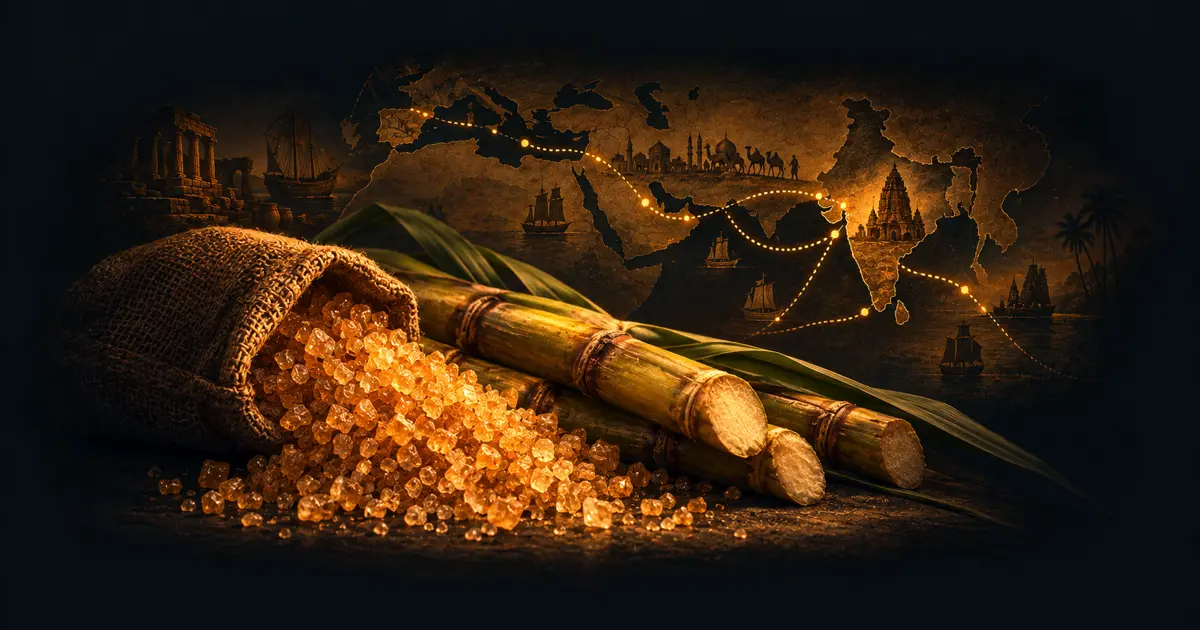
Let's go to India. The year is 327 BCE. A Greek general named Nearchus is marching with Alexander's army, and he is staring at a tall grassy plant he has no word for. So he describes it the only way he can: the reeds "produce honey, although there are no bees". Let me ask you something. You have said the word "sugar" thousands of times. Has anyone ever told you where it comes from? Rewind it through French, Latin, Arabic and Persian, or follow its cousin saccharum back through Greek, and every road ends at one Sanskrit word, sharkara. And here is the twist: that word originally meant gravel. I will walk you through the whole chain, link by link, with no leaps.
Continue with membership
Source Library
Pedanius Dioscorides, De materia medica II.104, ed. Curt Sprengel (Greek text with Latin translation; Leipzig: Cnobloch, 1829), vol. I, p. 231
archive.org
Original citation linked to this published story. Its downloadable Source record is still completing editorial publication.
Encyclopaedia Britannica, "Pedanius Dioscorides" (reference encyclopedia)
britannica.com
Original citation linked to this published story. Its downloadable Source record is still completing editorial publication.
James McHugh, History of Science in South Asia 8 (2020), "Sīdhu (Śīdhu): the Sugar Cane 'Wine' of Ancient and Early Medieval India" (peer-reviewed article), pp. 37–39
journals.library.ualberta.ca
Original citation linked to this published story. Its downloadable Source record is still completing editorial publication.
Sugar - Etymology, Origin & Meaning
Online Etymology Dictionary
Original citation linked to this published story. Its downloadable Source record is still completing editorial publication.
Pliny, Natural History, Book XII — Sugar
Pliny the Elder; translation hosted by Attalus
Original citation linked to this published story. Its downloadable Source record is still completing editorial publication.
Strabo, Geography, Book XV.1.20 — Nearchus and honey-yielding reeds
Fordham University, Internet Ancient History Sourcebook
Original citation linked to this published story. Its downloadable Source record is still completing editorial publication.