
Zoomed Vinay Special · First-person editorial
Panini Wrote a Grammar So Precise That Computer Scientists Noticed. Here Is What They Said, and What They Did Not
About 4,000 short rules. Every sound sorted by where your mouth makes it. Fourteen coded lines that compress the whole sound system. A modern linguist, Paul Kiparsky, has worked out why those fourteen lines are ordered the way they are; in 1967 a computer scientist, Peter Ingerman, proposed renaming a notation computer science treats as foundational "Panini-Backus Form" in Panini's honour, though the name never took hold. That is the firm part. And, told straight, the part this file does not claim: that Panini invented computer science, or that Backus and Naur took anything from him.
The point of view
Let me ask you something. When did you last think about where in your mouth a sound is made? Panini did, more than two thousand years ago, and he sorted every sound of Sanskrit that way. Then he squeezed the whole sound system into fourteen coded lines and built about 4,000 rules on top of them. A modern Western linguist, Paul Kiparsky, took those fourteen lines apart and showed how economically they are ordered. And computer scientists noticed too: in 1967 one of them proposed renaming a core notation of the field "Panini-Backus Form" in his honour. Here's what I want to show you. Not a slogan that "Panini invented computing". The actual record: what he built, who said what about it, and the one word that matters most in this whole story. Anticipated. Not originated. You decide.
1991: a linguist looks at a text two thousand years old
Let's start in 1991.
A linguist named Paul Kiparsky is looking at a grammar written more than two thousand years earlier. And he sets out to explain something remarkable: why those fourteen lines are in exactly the order they are. His answer is economy. The order lets the grammar name every group of sounds its rules need, in the fewest possible symbols.
Now listen carefully to who is saying this. This is not a claim from an Indian source with something to prove. It is an analysis by a Western academic linguist. He is examining the work on its own technical merits. More than two thousand years after it was written.
I like that. When someone with no stake in the outcome looks at work from our own tradition and takes it apart line by line to show how well it is built, that's worth more than a hundred proud speeches.
The work he was looking at is the Ashtadhyayi. What it is, and why computer scientists have noticed it too, is the whole of this file.
First, the words you need
Four words, and the rest is easy.
Ashtadhyayi. Panini's grammar of Sanskrit. Written sometime in the mid-1st millennium BCE. Built from roughly 4,000 short rules, called sutras. They cover everything from how nouns take suffixes, to how word roots transform, to how sentences are accented.
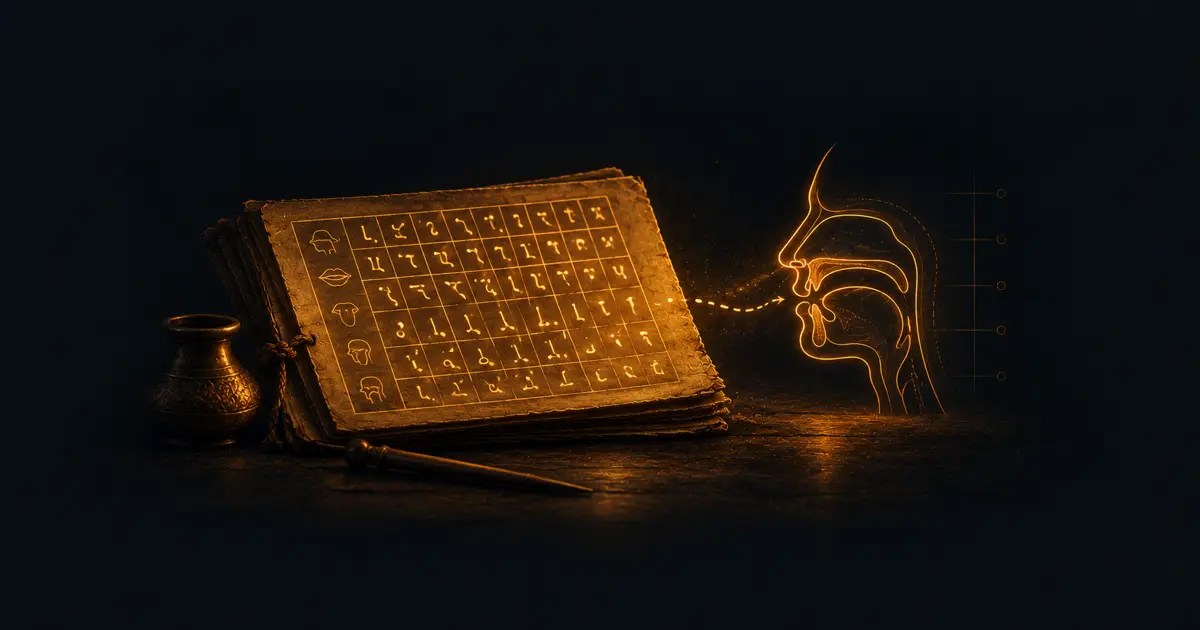
Point of articulation. Where in your mouth a sound is physically made. Back of the throat. The palate. The tongue curled back (that's called retroflex). The teeth. The lips.
Shiva Sutras (Maheshwara Sutras). Fourteen short lines at the front of the grammar. They arrange all of Sanskrit's sounds into a deliberately structured sequence, so the rest of the grammar can refer to whole groups of sounds by short codes.
Backus-Naur Form (BNF). A widely used notation in computer science for formally describing the grammar of programming languages. It is named after the two 20th-century computer scientists usually credited with inventing it.
What I'm testing, in two parts
There's a big version of this story that is very easy to write. "Panini invented computer science."
I'll be honest with you. Part of me wanted a sentence like that to be true. So I split it into two claims and checked each against the record. Here is what the evidence actually says.
- Panini classified sounds by point of articulation, compressed the sound system into fourteen coded lines, and built a rule system whose economy a modern linguist has analysed in detail and that a computer scientist compared to BNF closely enough to propose the name "Panini-Backus Form"; and the grammar is still used by people building software for Sanskrit. True, with the named assessments below.
- Panini invented computer science, or BNF was taken from him. Not claimed. The comparison is about structure. The word is "anticipated", not "originated".
Notice what part one does not say. It does not say anyone in the 20th century learned BNF from Panini. Hold on to that. We'll come back to it.
What Panini actually built
Think about it. Roughly 4,000 rules, covering a whole language.
That alone would be an impressive piece of scholarship. For any language. In any era.
But that's not what makes it genuinely unusual in the history of human thought. What makes it unusual is how he built it. So let's go through it, one clue at a time.
Clue 1: he sorted sound by where your mouth actually makes it
Try this right now. Say a few sounds out loud, slowly. Pay attention to where your tongue and lips actually move.
Feel that? Some sounds happen far back. Some happen at the teeth. Some right at your lips.
That, literally, is the organizing principle Panini used. He classified every sound in the language according to its actual physical point of articulation. Where your tongue and lips physically do the work.
And he did it over two thousand years before modern phonetics departments would formalize the same approach, with the same basic categories.
Think about that the next time you see a phonetics chart in a textbook.
Clue 2: the Shiva Sutras, fourteen lines that compress the whole sound system
Now here's the part I find genuinely beautiful.
The Shiva Sutras were not decorative. They were functional.
Imagine you're writing 4,000 rules. Again and again, a rule needs to say "this applies to all the vowels" or "this applies to this whole group of sounds". Do you list every single sound, every single time? You'd go mad. The book would be far longer.
So what did Panini do? He arranged the sounds in a specific order in fourteen lines. And that arrangement lets the rest of the grammar point to an entire group of sounds with a short abbreviated code. One small code instead of a long list.
It's like a contact group on your phone. Instead of typing twenty names every time, you type "Family", and the message goes to all of them.
That is a compression technique. Building an efficient shorthand for referring to categories of things. Worked out for a spoken human language, by hand, in ancient India.
And Kiparsky's 1991 analysis, the one we started with, is about exactly this.
Clue 3: a computer scientist proposed putting his name on a modern notation
Here's the detail that earns this file its place in this series. Listen carefully, because the exact words matter.
In 1967 a computer scientist, Peter Ingerman, pointed out something. Panini's method for defining grammatical rules was, he argued, as powerful as BNF, close enough that he proposed calling it the "Panini-Backus Form".
In plain words: he was treating Panini as having anticipated, by roughly two and a half thousand years, a formal technique that modern computing considers foundational.
And here's a small twist from the Source Library entry behind this. It points to a 1967 proposal, in Communications of the ACM, by Ingerman, to rename Backus-Naur form in Panini's honour. A proposal. The entry itself says it documents a proposed name and a formal-grammar comparison, not universal adoption of the name. So when you hear "Panini-Backus Form", hear it the right way: a proposed name that never took hold. Not the standard term.
So say it directly. A system built over two thousand years ago to describe a spoken human language used a structural approach close enough to a core tool of modern computer science that a computer scientist noticed, and proposed a name accordingly.
You don't need to stretch that. It's already something.
Why this matters beyond trivia
Let me ask you something. How many two-thousand-year-old texts are still doing a job today? Not sitting in a museum. Actually working.
Panini's grammar is one of them. It is still actively used.
Researchers building computational tools for Sanskrit today directly reference the Ashtadhyayi's rule structure. Why? Because it is precise and systematic enough to translate into modern algorithms with relatively little modification.
That is a genuinely rare thing for a text that old. It is not just a historical artefact being studied by historians. It is a working technical reference, still used by people building software.
Now the other side, honestly
So what's the fair objection? There are three, and I'm going to give you all of them.
The name. "Panini-Backus Form" was one computer scientist's 1967 proposal. It never became the standard term.
The history. Backus and Naur invented BNF without reference to Panini.
The word. "Anticipated" is a judgment about structural similarity. It is not a line of influence.
All granted. And notice that this file uses exactly those words.
But here's what the other side cannot dispute. The grammar itself. Its fourteen-line compression. And the fact that people building Sanskrit software use it today.
What I could not prove
I'll be straight with you about the edges.
- Any influence from Panini on Backus or Naur. None is claimed here.
- A precise date for the Ashtadhyayi. "Mid-1st millennium BCE" is the accepted range. Not a year. A range.
Why it still matters today
What follows is my own view.
This file belongs right after the Fibonacci piece, for one reason: same pattern, different field.
A rigorous, independently developed formal system. Built centuries or millennia before the West developed an equivalent. And on close technical inspection it turns out to be genuinely sophisticated, not merely old.
Pingala counted poetry and accidentally invented binary representation. Panini organized language and accidentally anticipated a core tool of modern computing.
Neither of these is a claim resting on pride. Both rest on named scholars and dated texts. And in Panini's case, on direct acknowledgment from modern specialists with no stake in the outcome either way.
If you ask me, that is the kind of pride worth having. Not "we did everything first". Something you can actually check.
The verdict
So let me put it all together.
The grammar book is as precise as I told you at the start. And the ones saying so are the ones with the least reason to: a modern linguist, and modern computer scientists.
That the Ashtadhyayi (mid-1st millennium BCE, about 4,000 sutras) classifies sounds by point of articulation, compresses the sound system into the fourteen Shiva Sutras, was analysed by Kiparsky in 1991 for its economy, was compared to BNF by a computer scientist who in 1967 proposed the name "Panini-Backus Form", and is used today by researchers building computational tools for Sanskrit, is true.
That Panini invented computer science, or that BNF was taken from him, is not claimed. The word is "anticipated".
What would change my mind: an earlier tradition with a coded sound system of this kind; evidence that the Sanskrit computing community has abandoned the Ashtadhyayi's rule structure. Neither exists in the record I read.
So be proud of Panini. Not for something he didn't do. For what he actually did, which is plenty.
Two and a half thousand years, and it still compiles. You decide what that's worth.
Corrections
31 October 2026. An earlier version of this file said that the linguist Paul Kiparsky called Panini's system "the first of its kind in human history", and that he showed no earlier linguistic tradition had organised sound this way. We graded that statement True. The paper of his that we cite, "Economy and the Construction of the Sivasutras", analyses how economically Panini's fourteen sound lines are ordered; it does not make that claim, and our own Source Library recorded that it was not located there. The file now describes what the paper does.
2 November 2026. An earlier version of this file said that "a modern programming notation is literally named after him", and that computer scientists "now name a programming notation after him". No programming notation is named after Panini. Backus-Naur Form is named after John Backus and Peter Naur. In 1967 the computer scientist Peter Ingerman proposed renaming it "Panini-Backus Form" in Panini's honour, and the name never took hold. The file also said that historians of computing call Panini's method by that name. Our only source for the name is Ingerman's proposal. The file now says it was his proposal.
Source Library
Economy and the Construction of the Sivasutras
Paul Kiparsky, Stanford University
Original citation linked to this published story. Its downloadable Source record is still completing editorial publication.
Parsing Techniques — Annotated Bibliography: Panini-Backus Form
Dick Grune and Ceriel J.H. Jacobs — Vrije Universiteit Amsterdam
Original citation linked to this published story. Its downloadable Source record is still completing editorial publication.
W. Sidney Allen, Oxford University Press, "Phonetics in Ancient India" (academic monograph, London Oriental Series 1, 1953), p. 20, (secondary: sound classes by place of…
archive.org
Original citation linked to this published story. Its downloadable Source record is still completing editorial publication.