
Zoomed Vinay Special · First-person editorial
In 1816 an English Surgeon Rebuilt Lost Noses and Wrote the Indian Method Into His Own Title. The Line Back to Sushruta Runs by Method, Not by Citation
A cart driver named Cowasjee lost his nose in South India in 1792. Two British surgeons watched it rebuilt from his own forehead and published what they saw in 1794; in 1816 an English surgeon, Joseph Constantine Carpue, did the same operation on two British army officers and credited the Indian method by name. That is the firm part. Then the text credited to Sushruta: a cataract technique, more than 300 procedures, around 120 instruments and eight branches of medicine. And, told straight, the parts that are not firm: the dates, and whether that surgeon of 1792 ever read the Samhita.
The point of view
Let's go to South India. The year is 1792, and there's a war on. A cart driver named Cowasjee has his nose and one hand cut off. About a year later, someone rebuilds that nose with skin from his own forehead. Two British surgeons stand there, watch every step, and write it down with diagrams. By October 1794 their account is in a London magazine, in front of readers who had never seen anything like it. In 1816 an English surgeon does the same operation and puts it in his own title: the Indian method. Here's what I want to show you. Not a slogan about who "started" plastic surgery, but the actual trail: the witnesses, the dates, the title, and the ancient text credited to Sushruta. And I'll tell you exactly which links are fixed on the record and which ones are not. You decide.
South India, 1792: a man loses his nose, and two British surgeons write down what they see
Let's go to South India. The year is 1792.
There's a war on. A cart driver named Cowasjee is caught in it. His nose and one hand are cut off. That was a punishment common at the time. Think about that for a second. Not an accident. A punishment.
About a year later, he has the nose rebuilt.
Now here's the detail I love. Two British surgeons are stationed nearby. Their names are Thomas Cruso and James Findlay. They watch the operation happen. And they do what any good witness should do: they write down exactly what they see, with diagrams.
Their account is published in the Madras Gazette. Then it is reprinted in London, in the Gentleman's Magazine, in October 1794. For a European audience who had genuinely never seen anything like it.
So what were they watching? Something called the "Indian method." Rebuilding a nose using skin from the patient's own forehead.
And listen carefully to this part, because it matters later. To the local surgeons, this was not a miracle. It was a technique they had been performing for a very long time, passed down as ordinary medical practice. To the British readers it was something new. To the Indian surgeon it was ordinary practice.
Hold on to that picture. A working practice, handed down. Not a book being read aloud. We'll come back to it.
First, the words you need
Five words, and the rest of this file is easy.
Forehead flap. Rebuilding a nose with skin taken from the patient's own forehead. This is the "Indian method".
Sushruta Samhita. A major ancient medical text, credited to Sushruta. It is most commonly dated to somewhere in the centuries before the Common Era. Not a year. A range. And it organizes surgery into its own detailed branch of medicine.
Couching. Sushruta's cataract technique. A curved needle physically displaces the clouded lens out of the direct line of sight.
Ashtanga Ayurveda. "The eight-limbed science of life." The text's division of medicine into eight named branches.
Svastha. Maintaining health. Ayurveda's own first priority, ahead of treating illness after the fact.
What I'm testing, in two parts
You've probably seen the big version of this story. "Modern plastic surgery started with Sushruta."
I'll be honest with you. I wanted that sentence to be true exactly as it's written. So I took it apart and asked what the record actually holds. Here is what the evidence actually says.
- The Indian forehead-flap method was witnessed and published by named British surgeons in 1794, adopted and credited by name by Carpue in 1816, and the Sushruta Samhita also describes cataract couching and catalogues hundreds of procedures and around 120 instruments. True, with the names, dates and titles below.
- Every date in this history is equally certain. Not so. Charaka's dates are genuinely debated, and I'll show you which dates are firm and which are not.
Notice what part one does not say. It does not say the surgeon of 1792 learned his method from the Samhita. Keep that in your head. It is the most honest sentence in this file, and we'll get to it.
Clue 1: the report that travelled to London
That 1794 report travelled.
Jump to 1816. An English surgeon named Joseph Constantine Carpue performs the same forehead-flap technique on two British army officers. And he publishes a full account of it.
Now look at his title. Read it slowly:
An Account of Two Successful Operations for Restoring a Lost Nose... Including Descriptions of the Indian and Italian Methods.
In plain words: "I fixed two noses, and here is how. Including the Indian method." He didn't hide where it came from. He put it on the cover.
Carpue's publication is widely credited as the moment reconstructive nasal surgery entered modern Western medicine. Notice the exact words there. Reconstructive. Nasal. Western medicine. Widely credited. Every one of those words is doing work, and I'm not going to quietly drop any of them to make the headline bigger.
And here's a small twist. Carpue's title names two methods. The Indian one, and an Italian one. So even in his own book, the Indian method sits next to a European one. That doesn't take anything away from the Indian method. It just tells you the honest shape of the story: Carpue knew both, and he named ours, in print, on the title page.
So whose name does that method lead back to? Sushruta, credited as the author of the Sushruta Samhita. And as you'll see, that link runs by method, not by citation.
And here I have to slow down. Because the nose is genuinely just one entry in a much bigger catalogue than most retellings let on.
Clue 2: a needle, a clouded lens, and an operation still taught today
Let me ask you something. Do you know someone at home, a grandmother, an uncle, who went in for cataract surgery?
A cataract is the clouding of the eye's lens. It causes blindness, and it is still one of the most common eye conditions in the world.
Sushruta described a technique for treating it. The method is called couching. A curved needle physically displaces the clouded lens out of the direct line of sight. And that restores at least partial vision.
Think about what that means. Something is blocking the window, so you push it aside, out of the line of sight. That is the idea.
Now, modern ophthalmologists who have studied the text closely note that his approach is close to what is now called extra-capsular cataract extraction. That is a real surgical category still taught today, just refined with modern tools and anaesthesia.
But I'm going to give you the careful version too. The eye-history article this rests on itself notes uncertainty over whether the ancient operation should be classified as couching or as partial extracapsular extraction. So "close to" is the right word. Not "the same as". Couching is an ancestor of modern cataract surgery, not the same operation.
What I can say firmly is this. It was not a lucky one-off. It was documented, in detail, as a repeatable surgical procedure, in a text that, on its most common dating, is over two thousand years old.
And one line, so nobody misreads me: this is history, not advice for anyone's eyes.
Clue 3: over a hundred instruments, and an actual system of specialties
Now imagine walking into a surgeon's room and seeing the tray. How many tools would you guess?
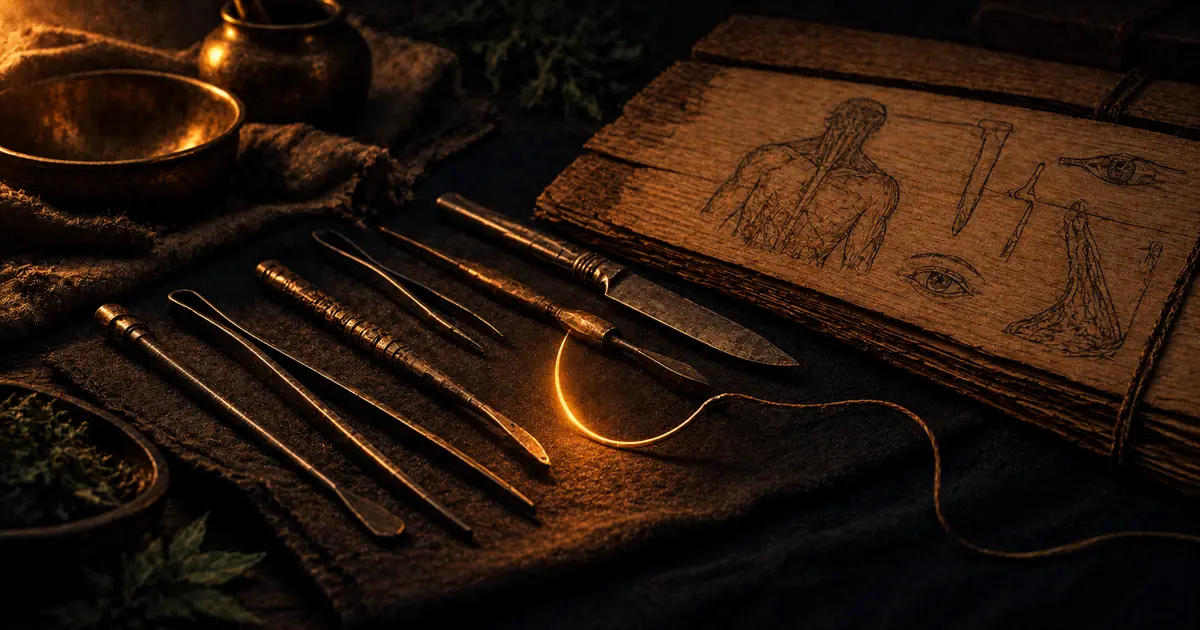
The Sushruta Samhita doesn't stop at a couple of impressive procedures. It catalogues more than 300 surgical procedures. And around 120 distinct surgical instruments, organized by function.
More than three hundred procedures. Around one hundred and twenty instruments. Sorted by what each one does.
And it goes further. The text organizes the entire field of Ayurvedic medicine into eight named branches. That's Ashtanga Ayurveda. Here they are:
- general internal medicine,
- specialized surgery,
- the branch covering eye, ear, nose, throat and head conditions (the one that includes his eye and nose work),
- toxicology,
- care of children,
- psychiatry,
- rejuvenation therapy,
- and a branch focused specifically on vitality and reproductive health.
Look at that list again. That is not a loose collection of home remedies. That is a structured medical curriculum with named specialties.
Think about your nearest big hospital. Surgery on one floor. Ophthalmology on another. Paediatrics down the corridor. Why? Because one doctor can't master everything, so you divide the field. That same basic instinct was worked out in ancient India, in writing, over two millennia ago, if the text's most common dating holds.
Charaka, and where the evidence gets more careful
Alongside Sushruta there is another major figure: Charaka.
Charaka is remembered as a systematizer of medicine more broadly. Reasoning through cases. Organizing knowledge. And describing learned medical assemblies where physicians debated and tested ideas against each other. Picture a room of doctors arguing a case until the weak idea loses. I find that beautiful.
But I'm going to be upfront with you. Charaka's exact dates are genuinely debated among historians. So I can't hand you a single confident year for him, the way I can hand you 1816 for Carpue.
Some parts of this history are precisely dated. Some are not. I would rather show you both kinds side by side than pretend everything is equally certain. Pride that needs fake certainty isn't worth much.
Prevention first, treatment second
One more thing worth understanding clearly.
Ayurveda's own internal framing puts svastha, maintaining health, ahead of treating illness after the fact.
That's not a small detail. Think of a house. You can fix the roof after it leaks. Or you can look after the roof so it doesn't. The system was not only built to fix people once they got sick. It was built, from the ground up, around the idea that staying well is the primary goal, and getting treated is the backup plan.
And that is a starting philosophy a lot of modern preventive medicine has circled back around to independently, centuries later.
Again, this is about how the system was framed. It is not a health tip, and it is not a cure for anything.
Now the other side, honestly
So what's the fair objection? It's about dating and distance.
Dating. The Sushruta Samhita is "most commonly dated" to the centuries before the Common Era. Not fixed to a year. And Charaka's dates are debated.
Distance. Remember Cowasjee? The 1794 witnesses were describing a living local practice. They were not reading Sushruta.
The eye. Couching is an ancestor of modern cataract surgery, not the same operation.
All of that is true, and I'm not going to wave it away.
But here's the thing. None of it touches the part that is firmest: a British-witnessed operation in 1792–94, and a British surgeon's 1816 title crediting the Indian method. Those two are on paper, with names and dates.
What I could not prove
I'll be straight with you about the edges.
- A year for Sushruta or for Charaka. The text's dating is a range; Charaka's is debated.
- That the 1792 surgeon had read the Samhita. The witnesses recorded a practice passed down as ordinary medicine; the line to the text is by method, not by citation.
And that second point is exactly why I won't write "modern plastic surgery started with Sushruta" as a fact. What the record shows is narrower, and I think stronger for being narrower: an Indian method, witnessed, published, and credited by name by Carpue, whose 1816 publication is widely credited as the moment reconstructive nasal surgery entered modern Western medicine. The link from that method back to the Samhita is a link of technique, not a footnote.
Why this still matters
What follows is my own view.
This piece sits third in the series, right after the two maths pieces, and for the same reason. The pattern is the same. Named techniques. Named British witnesses with a date. A named later publication that brought it into modern practice. All traceable. None of it resting on vague pride.
If you ask me, that is the kind of pride worth having. Not "we did everything first". Something you can actually check.
Sushruta, as the text credited to him shows, did not just describe one clever surgery. He catalogued an entire surgical system: instruments, specialties, and at least two separate procedures, nasal reconstruction and cataract couching. For the nose, the Indian method has a documented line running through 1794 and 1816 into modern Western nasal surgery; its link back to the Samhita is by method, not by citation. For the eye, there is a technique that modern ophthalmologists compare to a category still taught today.
You don't need to inflate that. It's already remarkable.
The verdict
So let me put it all together.
The firm part rests on a witnessed operation and a published title, and both are on the record.
That Cruso and Findlay watched and published the Indian forehead-flap operation (Madras Gazette; Gentleman's Magazine, October 1794), that Carpue performed and credited it by name in 1816, and that the Sushruta Samhita describes cataract couching and catalogues more than 300 procedures, around 120 instruments and eight branches of medicine, is true.
That every date here is equally certain is not so. Sushruta's text is dated to a range before the Common Era, and Charaka's dates are genuinely debated. I've told you which dates are firm and which are not, rather than smoothing the uncertain ones into the certain ones. Because the strength of the firm part does not depend on them. The 1794 report and the 1816 operation are fixed points, whatever the Samhita's exact century turns out to be.
What would change my mind: a European forehead-flap account earlier than the Indian one Carpue credited; a firm dating of the Samhita that moved it later than the European texts. Neither exists in the record I read.
So, pride and honesty, side by side. Be proud of the Indian method. It is real, it is ours, and a British surgeon wrote its name on his own title page. And let the bigger slogan go. We don't need it. The true story is better.
Carpue put it in his own title: the Indian method. You decide what that's worth.
Corrections
31 October 2026. An earlier version of this file was titled "Modern Plastic Surgery Started With an Ancient Indian Surgeon Named Sushruta", and said the line from Sushruta into modern medicine was direct and documented. The record shows something narrower: British surgeons witnessed the Indian forehead-flap nose operation in 1794, and Joseph Carpue named the "Indian method" in his 1816 book. The line runs by method, not by citation. The title and those passages have been corrected.
2 November 2026. An earlier version of this file also said, in its subtitle, that Sushruta described cataract surgery and catalogued surgical instruments "more than two thousand years before anyone in Europe did either". That was wrong. The Roman writer Aulus Cornelius Celsus, who lived from about 25 BCE to about 50 CE, described cataract surgery in his De Medicina, and repairs of the nose, lips and ears with skin flaps (R. F. Mazzola and I. C. Mazzola, "History of reconstructive and aesthetic surgery"). The line has been removed.
Source Library
"An Account of Two Successful Operations for Restoring a Lost Nose from the Integuments of the Forehead, in the Cases of Two Officers of His Majesty's Army; to which are…
wellcomecollection.org
Original citation linked to this published story. Its downloadable Source record is still completing editorial publication.
"'A Most Hideous Object': John Davies (1796–1872) and Plastic Surgery," John Symons, Medical History 45 (2001), pp. 395–402, Cambridge University Press (peer-reviewed medical…
doi.org
Original citation linked to this published story. Its downloadable Source record is still completing editorial publication.
The Indian method: Sushruta's influence on modern nasal reconstruction
ENT & Audiology News
Original citation linked to this published story. Its downloadable Source record is still completing editorial publication.
Joseph Constantine Carpue and the Bicentennial of the Birth of Modern Plastic Surgery
Indian Journal of Plastic Surgery / PubMed Central
Original citation linked to this published story. Its downloadable Source record is still completing editorial publication.
Ophthalmology in ancient india, Sushruta's time and the modern era
Eye News
Original citation linked to this published story. Its downloadable Source record is still completing editorial publication.