
Zoomed Vinay Special · First-person editorial
Pythagoras's Theorem Was Written Down in India Centuries Before Pythagoras. "Sine" Was Born From a Translation Mistake. Madhava Had the Series Roughly 250 Years Before Newton. And One Popular Claim the Record Does Not Support
Three documented clues from the history of Indian mathematics, explained from zero and told straight: an altar-builder's manual that states the rule around 800 BCE (most scholars' dating), with number triples and a geometric proof for one kind of right triangle; a Sanskrit word for "half-chord" that became the "sine" in your textbook through a chain of misreadings; and Madhava of Sangamagrama's infinite series for pi, sine and cosine around 1400, one core tool of calculus, roughly 250–300 years before Newton, Gregory and Leibniz found them again. And the claim I wanted to be true, that Newton copied Madhava: the record does not show it.
The point of view
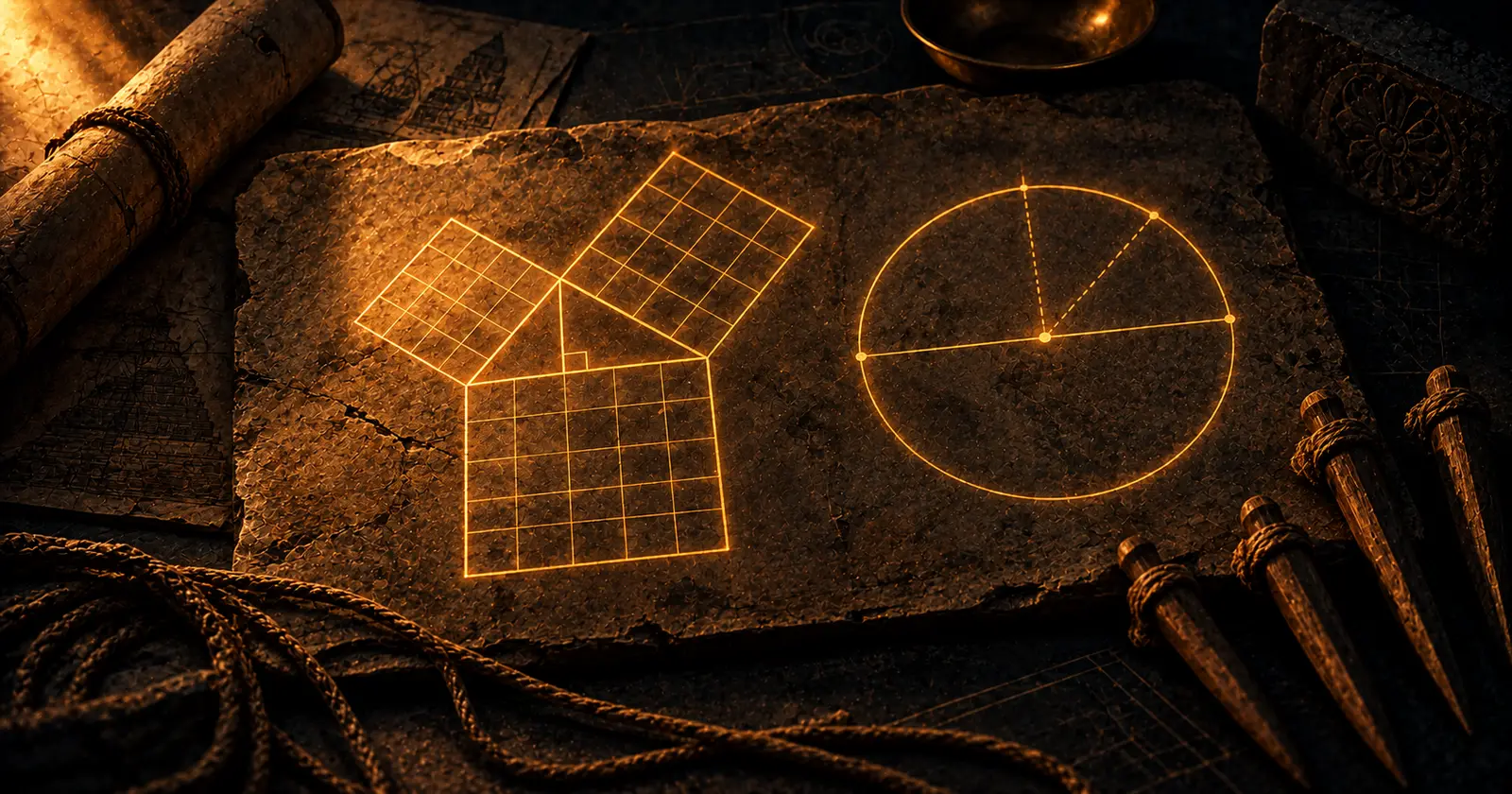
Picture a group of people, around 800 BCE, who have to build a fire altar to an exact, sacred specification. No rulers with printed numbers. No measuring tape. Only cords and stakes. They need exact right angles, and they write the method down so the next generation will not have to work it out again. The book they leave is the Baudhayana Sulba Sutra, and it states the rule you learned in school as the Pythagorean theorem. Pythagoras lived roughly between 570 and 495 BCE. Then a word: "sine". You wrote it in your homework for years. It started as an Indian astronomer's word for "half-chord" and reached English through a chain of mistakes. Then a man in Kerala, around 1400, with infinite series that Europe would find again, independently, roughly 250 years later. All three are documented. One popular claim on top of them is not. Let me show you which is which, and you decide.
Continue with membership
Source Library
Isaac Newton, De analysi per aequationes numero terminorum infinitas (1669; Royal Society MS/81/4), §[14], normalized transcription by The Newton Project (primary text)
newtonproject.ox.ac.uk
Original citation linked to this published story. Its downloadable Source record is still completing editorial publication.
Mathematics in the service of religion: II. Sulba Sutras
MacTutor History of Mathematics, University of St Andrews
Original citation linked to this published story. Its downloadable Source record is still completing editorial publication.
Aryabhata and the Construction of the First Trigonometric Table
arXiv preprint
Original citation linked to this published story. Its downloadable Source record is still completing editorial publication.
The Etymology of Sine
Cantor's Paradise
Original citation linked to this published story. Its downloadable Source record is still completing editorial publication.
On Madhava and his correction terms for the Madhava-Leibniz series for pi
arXiv preprint
Original citation linked to this published story. Its downloadable Source record is still completing editorial publication.
MacTutor History of Mathematics, University of St Andrews, "Madhava of Sangamagramma" (academic biography)
mathshistory.st-andrews.ac.uk
Original citation linked to this published story. Its downloadable Source record is still completing editorial publication.
Ranjan Roy, "The Discovery of the Series Formula for π by Leibniz, Gregory and Nilakantha", Mathematics Magazine 63:5 (December 1990), pp. 291–306 (peer-reviewed article)
doi.org
Original citation linked to this published story. Its downloadable Source record is still completing editorial publication.