
Zoomed Vinay Special · First-person editorial
Dharma Is Not Simply "Your Duty": the Root Means "To Hold Up", and You Are Holding Up More Than One Thing
Most English translations of "dharma" land on "duty" or "religion". They are in the neighbourhood, but they are not the root, and the difference matters. The word comes from a root that means to bear, to hold up, to support. Let's build it from zero: the root, why you carry several dharmas at once, what Svadharma and the Bhagavad Gita say about living your own version, and the four aims dharma is meant to be held in balance with. One claim is true, one is near but not the root, one is not so, and I tell you which is which. And one honest line up front: this is a way of thinking, not a treatment.
The point of view
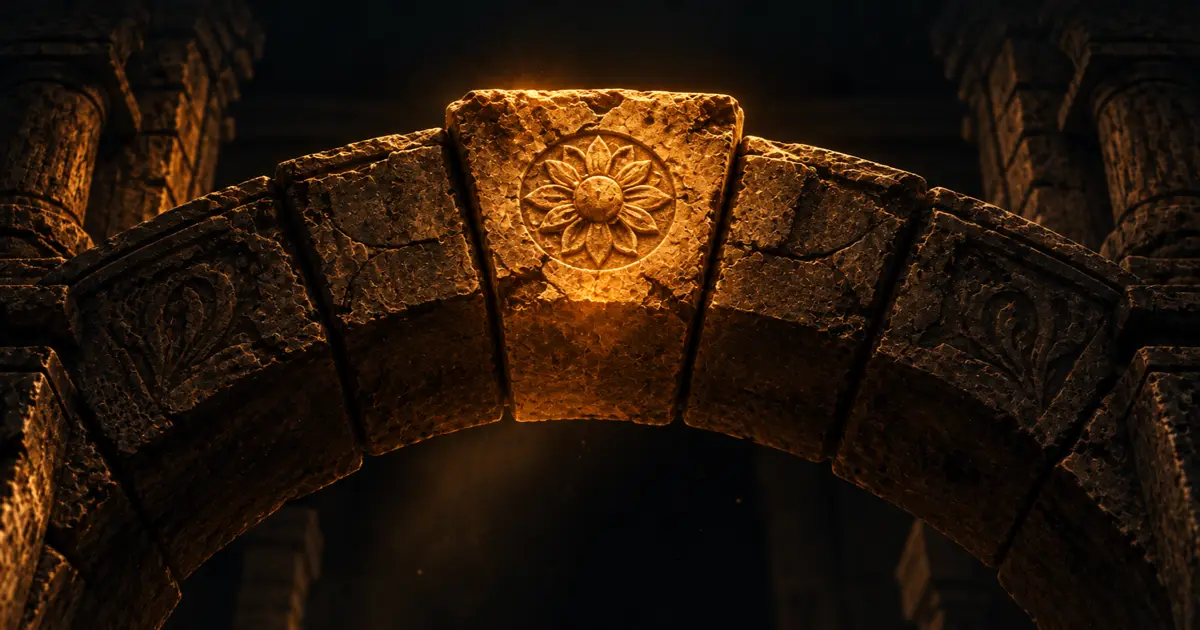
Stand under an old stone archway and look straight up. See that one wedge-shaped stone at the very top? The keystone. Every other stone in the arch is leaning on it. Pull it out and the whole arch comes down. Now let me ask you something: is that stone "in charge" of the arch? Is it "obeying" the arch? Neither. It is simply the thing that keeps everything else standing. Hold that picture, because it is far closer to what the word "dharma" points at than "duty" has ever been. The root of the word means to bear, to hold up, to support. I will walk you through it from the very beginning, I will give you the other side honestly, and I will tell you exactly where the old teaching ends and this piece's own reading begins.
A stone archway, and the one stone the whole thing is leaning on
Stand under an old arched doorway. Now look up.
At the very top there is a single wedge-shaped stone. The keystone. Every other stone in that arch leans against it. Pull it out and the whole arch comes down, even though every other stone looked perfectly fine on its own.
Now think about it. Is that keystone "in charge" of the arch? No. Is it "obeying" the arch? Also no.
It is simply the thing whose presence keeps everything else standing correctly, in relation to everything else.
Hold that picture. Keep it in your head for the rest of this file. Because it is a far closer image of what the word "dharma" is actually pointing at than "duty" has ever been.
First, the words you need
Five words. Learn them once, and the rest of this file is easy.
Dhar. The Sanskrit root "dharma" comes from. It means to bear, to hold up, to support. Not to obey. Not to worship. To hold something up so it does not collapse.
Dharti. The Hindi word for planet Earth. It comes from the Sanskrit dharitrī, from the same root; Sanskrit also calls the Earth dharā, "the bearer". Earth is called Dharti because it is the thing that holds up, bears the weight of, every living being standing on it.
Svadharma. "Sva" means "one's own". So, literally, "your own dharma", as opposed to the generic, one-size-fits-all version.
Dharma Shastras. A body of traditional law. One of the sources the Svadharma teaching is built from, alongside the Vedas, the Upanishads and the Bhagavad Gita.
Purushartha. Literally "the aims of a person". The four things this philosophy says must be held in balance: Dharma, Artha, Kama and Moksha. I define each one below.
Three claims, three grades
Here is what this file tests. I grade each one now, so you know where we are going.
- "Dharma" comes from the root Dhar, meaning to bear or hold up, as in Dharti for Earth; dharma is role-specific and plural, not one rule for everyone; Svadharma teaches living your own version rather than imitating someone else's; and dharma is one of four Purushartha meant to be balanced, not the one that cancels the others. True, with the coursework and the sources below.
- That dharma means "duty", "religion" or "righteousness". In the neighbourhood, but not the root. And the difference is the whole point.
- That dharma means self-denial, abandoning money and desire. Not so. For someone living in the world, the framework explicitly requires Artha and Kama.
One true, one near but not the root, one not so. Now let's go inside the first one.
Clue 1: the root, and the clue that it is not a cute interpretation
Dharma comes from Dhar. To bear. To hold up. To support.
Now, I know what you are thinking, because I thought it too. That sounds lovely. Maybe a little too lovely. Is this just a nice reading somebody invented later to make an old word feel modern and gentle?
Listen carefully, because this is the part that settled it for me.
The Hindi word for Earth is Dharti, from the Sanskrit dharitrī. Same root. Why? Because Earth is the thing that bears the weight of everything standing on it. You, me, every tree, every building, every river. Earth holds all of it up.
Put that in plain words: the same root that names the ground under your feet is the root inside "dharma". Once you know that connection, "dharma" stops sounding like a rulebook. It starts sounding like a foundation. The structure underneath everything else that keeps it from falling apart.
That is the keystone again. Not authority. Load-bearing.
Clue 2: you do not have one dharma, you have several at once
Here is where it gets practical.
This part is drawn from material taught in Hindu University of America's coursework on this exact subject: their "Hindu Contributions To The World In The Realm of Mind" programme and their dedicated Svadharma course. And the point is simple. Dharma is not one rule applying to everyone the same way. It is role-specific.
A published breakdown of this idea lists it plainly. One person can simultaneously carry the dharma of a citizen, a teacher or student, a spouse, a parent, a child, a sibling, a friend. And each role comes with its own version of "what holds this relationship up and keeps it from collapsing".
Do a small thought experiment with me. Think of yourself as someone's child. What holds that relationship up? Now think of yourself as someone's friend. What holds that one up? Different answers, right? Your dharma as someone's child looks different from your dharma as someone's parent, which looks different again from your dharma as a friend or a citizen.
None of them cancel each other out. You are holding all of them up at once, like several arches sharing one keystone.
Why does that matter? Here I am crossing from the teaching into this piece's own reading, so let me mark it. My view is that a lot of the identity confusion, burnout and "I do not know who I am any more" feeling can come from treating yourself as though you are supposed to have exactly one fixed role. One fixed purpose. One single correct way to be a person. And then panicking when that one thing feels wrong, or gets taken away.
A job ends. A relationship ends. A role you built your whole identity around disappears.
Dharma, understood properly, says you were never just one thing. You are many roles simultaneously. The collapse of one does not have to mean the collapse of all of you, because the others are still standing. Still real. Still yours.
Clue 3: Svadharma, your version and not the generic one
Now the word I promised you: Svadharma.
Let me ask you something. When most people hear "duty", what do they picture? A script. Everyone must follow the same one. Do what is expected. Fall in line.
The core teaching of Svadharma is almost the opposite. It is not "everyone must follow the same script". It is "figure out the version of this that is honestly yours, given your specific nature, your specific stage of life, your specific circumstances, and live that, instead of copying someone else's".
And here is what the source itself says, in plain words. The Bhagavad Gita, chapter 3, verse 35, says it almost bluntly:
It is better to imperfectly live your own dharma than to perfectly imitate someone else's.
Read that again. Slowly.
Put it in plain words: badly doing your own honest thing beats perfectly doing someone else's. Why? Because someone else's "perfect" was never built for your situation in the first place.
Now think about how you actually spend your evenings. Scrolling. Someone's job, someone's house, someone's wedding, someone's holiday. And at the end of it a quiet voice says, "I am failing, because I am not doing it their way." That is a very common and very damaging modern habit, constantly comparing your life to someone else's. And this verse directly contradicts it. The teaching says the opposite.
It is like wearing a friend's spectacles because they cost more than yours. They are excellent spectacles. They were made for his eyes. On you, the whole world is a blur.
Clue 4: the four things dharma is supposed to be in balance with
Dharma does not stand alone in this philosophy. It is one of the four Purushartha, all meant to work together:
- Dharma: the thing that holds you together.
- Artha: building the resources to live comfortably. Money, career, stability.
- Kama: fulfilling your actual human desires and needs comfortably. Relationships, pleasure, enjoyment. This is not a forbidden category. It is an explicitly required one.
- Moksha: liberation. The comfort and freedom of no longer being anxiously gripped by any of the above.
Now here is the twist, and it surprises people who have only heard dharma described as self-denial or sacrifice.
For someone living in the world, this framework does not ask you to abandon Artha or Kama in favour of Dharma. Only the renunciant's path, sannyasa, gives them up. For everyone else, it says all four must be held in balance, with Dharma acting as the structural support that keeps the pursuit of money and desire from collapsing into something destructive or hollow.
Think about it with the arch again. Artha and Kama are stones in the arch. Real stones, needed stones. Dharma is the keystone that lets them stand together instead of falling on your head.
Chase Artha and Kama with no Dharma underneath them and you get exactly the kind of success that looks fine from outside while feeling completely empty inside. Achieving everything you thought you wanted, and still feeling nothing.
Now the other side, honestly
The sceptic has two points. Let me give them to you in full, because he is right on both.
One. "Duty" is not a random mistranslation. In the Dharma Shastras, dharma really does arrive as obligation, often as obligation assigned by birth and station. A reading built only on the etymology can quietly skip past that.
Granted. That fits the grade this file gives "duty": in the neighbourhood, but not the root.
Two. "You have many dharmas, so one collapsing is survivable" is a comforting modern application. It is not a claim the ancient sources set out to make.
Also granted. So the practical section below is offered as this piece's own reading, not as scripture's, and so is the end of Clue 2. I will mark the line again when we cross it.
On the record: every claim in one place
Here is the whole file, sorted.
True - "Dharma" derives from the root Dhar, meaning to bear or hold up, the same root as Dharti for Earth. - Dharma is role-specific: one person simultaneously carries the dharma of citizen, teacher or student, spouse, parent, child, sibling and friend. - Svadharma, taught in Hindu University of America's dedicated course and built from the Vedas, Upanishads, Bhagavad Gita and Dharma Shastras, teaches living your own version rather than imitating another's; the Gita holds that imperfectly living your own dharma beats perfectly imitating someone else's. - Dharma is one of four Purushartha, Dharma, Artha, Kama and Moksha, meant to be balanced rather than traded against each other.
In the neighbourhood, but not the root - That dharma means duty, religion or righteousness.
Not so - That dharma demands abandoning money and desire. For someone living in the world, Artha and Kama are explicitly required; only the renunciant's path gives them up.
What I could not prove
Two things. I will say them as plainly as the true parts.
- That the traditional sources intended Svadharma as an answer to burnout or identity confusion. The teaching is as described; the modern application is ours.
- The identity of the published breakdown listing the roles, beyond what the current record cites. The roles are listed as the record lists them.
Why it still matters today
Here is the line I promised. What follows is this piece's own view.
If you are in a depressive stretch where you genuinely do not know who you are any more, or you feel you have failed at "your purpose" because one specific role or plan fell apart, here is the usable version of everything above.
You are not one role. You are not required to have already found "the one purpose". You have several dharmas running simultaneously right now: as someone's child, maybe someone's friend, maybe a student or a worker, maybe a sibling. Even if one of those feels broken or lost today, the framework does not ask you to have a single answer nailed down. It asks you to look honestly at where you actually stand, in each of your actual roles, and ask what genuinely holds each one up. Not what would impress someone else. Not a stranger's version of success. Yours, as you actually are.
Now compare two questions.
"What is my purpose in life?" Usually too big and too vague to answer. It ends up generating more anxiety.
"What honestly holds up my role as a friend, a sibling, a student, this week?" That one you can actually answer.
And answering it, even in a small way, is Svadharma in practice. Not a grand cosmic destiny. Just showing up honestly for the roles you are already standing in.
And the caveat, once more, because it matters every time this subject comes up. If what you are feeling is not identity confusion or burnout but a genuine, sustained depression, hopelessness, loss of interest in everything, thoughts of not wanting to continue, then this framework is a way of thinking, not a treatment plan. It does not replace talking to an actual mental health professional. Understanding your dharma more clearly can genuinely help with the "who am I, what's the point" spiral that so often rides alongside depression. It is not, on its own, a cure for the underlying illness, and it was never claimed to be one. A philosophy for living and a treatment for a medical condition are two different things.
The verdict
Dharma is not simply your duty. It is what holds a thing up, and you are holding up several things at once, which is why losing one of them is not the end of you.
That "dharma" derives from the root Dhar, meaning to bear or hold up, the same root as Dharti for Earth; that dharma is role-specific, so one person simultaneously carries the dharma of citizen, teacher or student, spouse, parent, child, sibling and friend; that Svadharma, taught in Hindu University of America's dedicated course and built from the Vedas, Upanishads, Bhagavad Gita and Dharma Shastras, teaches living your own version rather than imitating another's, with the Gita holding that imperfectly living your own dharma beats perfectly imitating someone else's; and that dharma is one of four Purushartha, Dharma, Artha, Kama and Moksha, meant to be balanced rather than traded against each other, is true.
That dharma means duty, religion or righteousness is near, but not the root.
That it demands abandoning money and desire is not so; outside the renunciant's path, Artha and Kama are explicitly required.
What would change my mind? An etymology placing dharma at a root meaning obedience rather than support. A primary source teaching a single dharma per person. Neither exists in the record I read.
So look up at that arch one more time. You are not one arch. Losing a stone from one of them does not bring down the rest. Which stones are you holding up this week? You decide.
Corrections
2 November 2026. An earlier version of this file was titled "Dharma Doesn't Mean 'Your Duty'", called the translations "duty" and "religion" "quietly wrong", and ended its verdict "Dharma is not your duty". The standard Sanskrit dictionary, Monier-Williams, lists "duty" among the meanings of dharma, and the file's own grade called that reading "in the neighbourhood"; the title and verdict now say dharma is not simply duty. The file also called Dharti "the Sanskrit word" for Earth. Dharti is Hindi; it comes from the Sanskrit dharitrī, and Sanskrit also calls the Earth dharā, all from the same root. And it stated as fact that success without meaning is "a documented and common contributor to depression", and that "a huge amount" of identity confusion and burnout comes from having one fixed role. We have no source for either; the first has been removed and the second is now marked as the writer's view. It also said the framework never asks anyone to abandon Artha or Kama. The renunciant's path, sannyasa, gives up both. The file now says so.
Source Library
Svadharma — Discovering and Living Our Life Purpose
Hindu University of America
Original citation linked to this published story. Its downloadable Source record is still completing editorial publication.
Hindu Contributions to the World in the Realm of Mind — HSF1204
Hindu University of America
Original citation linked to this published story. Its downloadable Source record is still completing editorial publication.
Understanding Hindu Dharma
D. K. Hari and D. K. Hema Hari — Bharath Gyan
Original citation linked to this published story. Its downloadable Source record is still completing editorial publication.