
Zoomed Vinay Special · First-person editorial
Before Vaccines Had a Name, India Was Already Preventing Smallpox. A British Surgeon Wrote It Down in 1767. Here Is What His Letter Says.
In 1767 J.Z. Holwell, a British surgeon and writer, sent London's Royal College of Physicians a detailed account of how smallpox inoculation was done in India, from what he had observed or gathered from correspondents there. That letter still exists, and so does a second clue: a Sanskrit horse-medicine text with a translation trail into Persian and Tibetan. Here is what both prove, what they do not, and why "Jenner learned it from India" is not a claim this file makes.
The point of view
Let me take you to 1767. A British surgeon named J.Z. Holwell writes a formal medical account and addresses it to the President and members of London's Royal College of Physicians. His subject: how people in India were inoculating against smallpox. Not a rumour, not a folk tale. Material chosen carefully, prepared a specific way, given at a specific time, followed by specific aftercare. He even recorded that bad smallpox years came in a roughly seven-year cycle. That is twenty-nine years before Jenner's cowpox in 1796. So did Jenner learn it from India? I wanted that to be true too. Here is what the evidence actually says, and you decide.
1767: a letter addressed to London's Royal College of Physicians
Let me ask you something. When you hear the word "vaccine", whose name comes into your head?
Edward Jenner. 1796. Cowpox. That is the story most of us were taught, and the important part of it is true. I will come back to it.
But now let's go back twenty-nine years before that. 1767.
A British surgeon and writer named J.Z. Holwell sits down and writes a detailed account. Its title is An Account of the Manner of Inoculating for the Small Pox in the East Indies. And look at who it is addressed to: the President and members of London's Royal College of Physicians.
So let's be clear about what this document is, because everything in this file stands on it. It is a formal medical letter. A named author, writing to a named institution, describing what he had personally observed or gathered from correspondents in India. It is dated. It is on paper. And it is still there: the Wellcome Collection holds a digitised copy of it today.
That letter is the centre of this file. Everything in it is dated, named and on paper. And so is the second clue: a Sanskrit veterinary text, with a translation trail into Persian and Tibetan.
One thing before we start, and I mean it. This is a history file. It is not medical advice. What Holwell described meant deliberately giving a person smallpox itself. Nobody should read this as a reason to try anything like it, or as a reason to doubt vaccines. The point of this file is the record of what our people knew and did, not a recommendation for today.
First, the words you need
Variolation. Deliberately giving someone a controlled, small exposure to smallpox itself, taken from an existing mild case, so the body could build defences before facing the disease at full strength.
Vaccination. Edward Jenner's 1796 method, and a different one: using cowpox, after he noticed that milkmaids who had caught it seemed protected from smallpox. A genuinely important scientific breakthrough. Remember that word "different". It matters later.
Svastha. Maintaining health before illness strikes. Prevention before cure. The preventive philosophy this file sees running through both clues.
Shalihotra Samhita. A Sanskrit veterinary text credited to a physician remembered as Shalihotra. Ashva Ayurveda is the related "horse life-science".
Three claims, in three lines
Here is what we are testing, and the grade each one gets. I am telling you the grades now, so nothing is hidden for a twist later.
- An organized smallpox-prevention practice existed in India and was written down in detail by a named British eyewitness in 1767, decades before Jenner; and a named Indian veterinary text was translated into Persian and Tibetan. True, with the letter and the text below.
- Jenner learned his vaccine from Indian variolation. Unsupported. That is a separate question about cause, the record in this file does not answer it, and I am not going to assume it either way.
- Serious horse-medicine knowledge must have been imported into India from outside. Undercut by the Shalihotra text itself: a homegrown, named-author text worth translating into Persian and Tibetan.
Clue 1: a British surgeon's own letter, 1767
So what did Holwell actually describe?
Think about what a "folk superstition" looks like. Someone does something because their grandmother did it. No method. No reason anyone can explain. Now think about what a medical procedure looks like. Steps. Timing. Care afterwards.
Holwell's account is the second kind. He described the practice as organized and deliberate, not folk superstition. The material was selected carefully. It was prepared in a specific way. It was given at a specific time. And it was followed by specific aftercare.
Selection, preparation, timing, aftercare. Read those four words again. That is a procedure.
Now listen carefully, because this is the detail I like most.
Holwell also recorded that severe smallpox outbreaks in the region followed a roughly seven-year cycle, with milder years in between. A modern epidemiologist would recognize that immediately: a disease with a pattern across years.
Ask yourself what it takes to notice something like that. You cannot see a seven-year cycle in one bad season. You have to be watching the disease, year after year, long enough to see the bad years come round again. So what does that detail tell us? The people practising inoculation, as this file reads Holwell, had been tracking the disease's real-world pattern over a long period, carefully enough to notice a seven-year cycle, not reacting to it at random.
So let me put it plainly, with no hedging. What this evidence proves: a real, structured smallpox-prevention practice existed in India, and a named British surgeon wrote it down in detail, decades before Jenner's 1796 cowpox discovery. 1767 to 1796. Twenty-nine years.
Did Jenner learn it from India? I wanted this to be true too
Now the question everybody asks next. I will be honest with you: I asked it too.
Jenner learned it from us. Right? It sounds so neat. A British surgeon writes to London about Indian inoculation, and a few decades later an Englishman gets the credit for vaccines. I wanted this to be true too.
Here is what the evidence actually says.
Holwell's letter proves a practice. It does not, by itself, prove that Jenner personally learned anything from Indian variolation. That is a separate historical question about a specific link of cause and effect: who read what, who learned from whom. It deserves its own dedicated research, not an answer assumed in either direction.
And remember the word I asked you to hold on to: different. Variolation used smallpox itself. Jenner's method used cowpox. They are scientifically distinct, and Jenner's was a real breakthrough. Saying so takes nothing away from the people Holwell wrote about. Both things are true at once: India had an organized prevention practice on paper in 1767, and Jenner's cowpox method was a genuine discovery of its own.
So if someone forwards you a message saying "Jenner copied India", here is what this file can tell you: the record we read does not show that. It does not show the opposite either. Unsupported, in either direction. That is the honest answer.
Clue 2: a horse-medicine text, in three languages
Now the second clue. The same preventive philosophy, svastha, reached animal medicine too. And here the evidence is even more concrete.
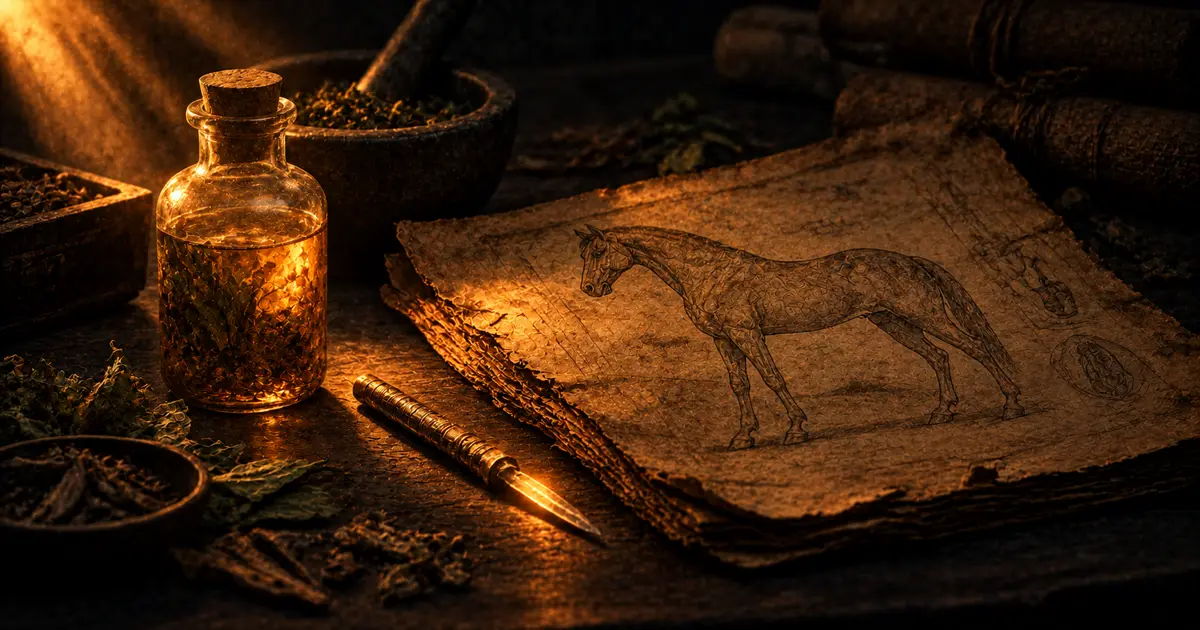
Shalihotra is credited with the Shalihotra Samhita, a Sanskrit text on horse medicine.
He is also credited with a related, dedicated system called Ashva Ayurveda: a full medical framework built specifically for horses, distinct from human Ayurveda but standing on the same underlying principles.
Now listen carefully to the next part, because it is remarkable on its own.
The Shalihotra Samhita was translated into Persian and Tibetan. Think about what that means. A veterinary text from India was being read and used in translation across the Persian-speaking and Tibetan-speaking worlds.
Here is an everyday way to see it. People do not go to the trouble of translating a book into other languages unless it is worth having. That is not a local farming manual. That is a text with a documented reach across several civilizations.
The twist: who taught India about horses?
There is a claim that sometimes gets made carelessly. It goes like this: serious horse-breeding and horse-medicine knowledge must have been imported into India from outside, from cultures assumed to be "naturally" more horse-focused.
Let me ask you something. If that were true, what would you expect to find? You would expect India's horse knowledge to be borrowed, thin, translated in from somewhere else.
What do we actually find? A homegrown, named-author text that other major language worlds thought worth translating into their own languages.
That is direct evidence against that assumption, not for it. Undercut. And notice, I am not saying anything about any other culture's horses. I am saying only what this one text shows about ours.
Now the other side, honestly
The other side can say, fairly, three things about the smallpox letter. Variolation and vaccination are scientifically distinct. Jenner's cowpox method was a real breakthrough. And Holwell's letter proves a practice, not a line of influence. I agree with all three. This file says all three itself.
On the horse text, the other side can say something fair too: the manuscript history has not been fully reviewed. So not every claim inside the text as we have it today can be treated as belonging to its earliest core. I concede that as well. You will see it again in a moment, under what I could not prove.
On the record: every claim in one column
Here is the whole file, sorted. Every claim sits in one place.
True, on the record - An organized, deliberate smallpox-prevention practice in India (careful selection, preparation, timing, aftercare, and an observed seven-year outbreak cycle) was set down by J.Z. Holwell for London's Royal College of Physicians in 1767, decades before Jenner's 1796 discovery. - The Shalihotra Samhita, a Sanskrit text on horse medicine, was translated into Persian and Tibetan.
Unsupported, in either direction - That Jenner learned his vaccine from Indian variolation.
Undercut - That serious horse medicine had to be imported into India from outside.
Not claimed by this file - That variolation and vaccination are the same thing: they are scientifically distinct. - That every passage of the Shalihotra Samhita as we have it today belongs to its earliest core. - Anything about variolation as a practice for today. This is history, not advice.
What I could not prove
- The manuscript history of the Shalihotra Samhita. Which surviving copies are oldest, and how much of the text as we have it today matches its earliest core versus later additions. That needs more specialist review before every specific claim inside it can be treated as equally solid.
- The precise historical relationship between early Indian variolation and Jenner's later, scientifically distinct vaccination. A real, separate research question that deserves its own full file, not a paragraph tacked onto this one. Better to tell you that gap straight than to cover it with a confident-sounding sentence I cannot back up yet.
Step back for a minute
What follows is my own view.
This one is fourth in the series because it is the same pattern again, just in medicine instead of mathematics. A named British observer, with a real letter and a real date. A named physician, with a real text. And a documented trail of that text into Persian and Tibetan.
That is the kind of pride I want us to have. Not a vague "we knew everything first" that falls apart the moment someone asks for proof. A specific claim, one you can trace back to its own paper trail, said plainly, with the gaps said just as plainly. Pride that survives the question "show me" is the only kind worth keeping.
The verdict
Before the word existed, the practice did, and a British surgeon wrote it down for London in 1767.
That an organized, deliberate smallpox-prevention practice (careful selection, preparation, timing, aftercare, and an observed seven-year outbreak cycle) was documented by J.Z. Holwell to the Royal College of Physicians in 1767, decades before Jenner's 1796 discovery, and that the Shalihotra Samhita was translated into Persian and Tibetan: true.
That Jenner learned from Indian variolation: unsupported in this record, in either direction.
That horse medicine had to be imported into India: undercut by a homegrown, named text worth translating into Persian and Tibetan.
What would change my mind? A specialist review of the Shalihotra manuscripts that moves the text's core later. A documented link between Indian variolation and Jenner, or a documented absence of one. Neither is in the record I read.
The letter still exists. Read what it actually says, and you decide.
Source Library
An account of the manner of inoculating for the small pox in the East Indies
John Zephaniah Holwell / Wellcome Collection
Original citation linked to this published story. Its downloadable Source record is still completing editorial publication.
Smallpox in the modern scientific and colonial contexts 1721–1840
Journal of Biosciences / Springer Nature
Original citation linked to this published story. Its downloadable Source record is still completing editorial publication.
A brief history of vaccines & vaccination in India
Indian Journal of Medical Research / PubMed Central
Original citation linked to this published story. Its downloadable Source record is still completing editorial publication.
"Faras-nāma", Īraj Afšār, Encyclopaedia Iranica (online edition, 15 December 1999; academic reference)
web.archive.org
Original citation linked to this published story. Its downloadable Source record is still completing editorial publication.
"Śalihotra's Compendium on Equine Medicine" (Toh 4345), 84000: Translating the Words of the Buddha (institutional catalogue of the Tibetan canon)
84000.co
Original citation linked to this published story. Its downloadable Source record is still completing editorial publication.