
Zoomed Vinay Special · First-person editorial
Ashwagandha Went Through Modern Medicine's Own Test: 15 Studies, 873 Patients, a Measurable Effect on Stress and Cortisol — and What That Does Not Prove
Ayurveda sorts you into three "doshas" and blames anxiety and depression on whichever one is out of balance. At first glance that sounds like astrology. But one herb this system has used for centuries has now been put through real, modern, placebo-controlled trials, and the stress and cortisol results are hard to wave away. Here is the honest version: what is folklore, what was measured, where the line sits, and why none of it replaces your doctor.
The point of view
Picture a patient in ancient India who cannot sleep, cannot sit still, cannot stop the worries. The physician does not say "toughen up." He has a name for it, and a root on the shelf behind him. That root is Ashwagandha, and it has now been through the same kind of blinded trial used to test new drugs. Let me ask you something: when an old remedy passes that test, does it prove the old theory behind it? I will show you exactly what the trials found, the one big thing they did not test, and the warnings you must not skip, starting with this one: none of it replaces your doctor.
A consulting room in ancient India: a patient who cannot sit still
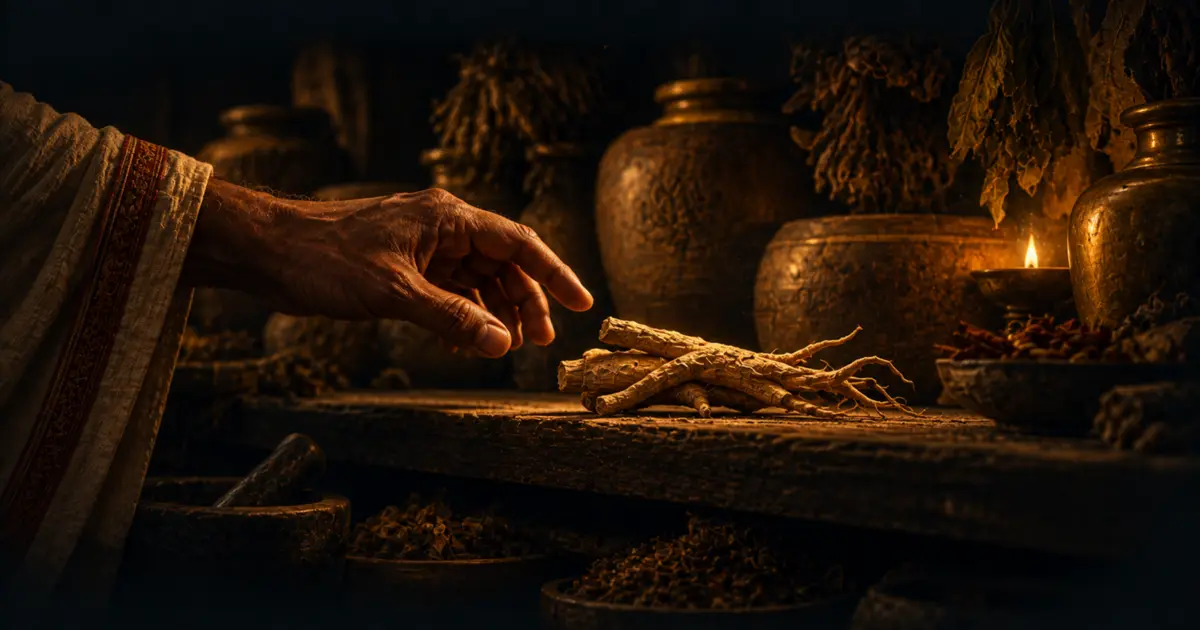
Picture this. A consulting room somewhere in India. I cannot give you a date. Maybe two thousand years ago.
A physician is sitting across from a patient. The patient cannot sleep. Their thoughts will not stop moving. One worry, then the next, then the next, never landing anywhere long enough to rest. Their hands will not stay still.
Now think about what the physician can see. No wound. No fever. Nothing a physician of that era could measure. Just a person who is visibly, physically unable to settle.
And here is the thing. He does not tell them to toughen up. He does not call it a mood.
He has a name for exactly this pattern. A category it belongs to. And a specific root he is about to reach for on the shelf behind him. Because people have been walking in with this exact set of symptoms for as long as anyone can remember, and, in the tradition's telling, there is already an answer for it.
That root is still on shelves today. It is called Ashwagandha.
And in modern times it has been made to sit through the same kind of test modern medicine puts every new drug through. The one where nobody, not even the researchers, is allowed to know who is getting the real thing until the results are locked in.
So did it pass? And if it did, what exactly did it pass? Those are two different questions. Listen carefully, because this whole file lives in the gap between them.
First, the words you need
A few terms. Learn them once and the rest of this file is easy.
Ayurveda. India's traditional system of medicine. The word breaks down as "Ayur" (life) and "Veda" (knowledge). Literally, the knowledge of life. It is thousands of years old.
Doshas. Ayurveda's three fundamental forces governing body and mind. Everyone has all three, in their own personal ratio. Health is said to depend on keeping that mix in its natural balance.
- Vata governs movement: the nervous system, breath, anything that moves or flows. Balanced, you are adaptable and quick-thinking. Out of balance, the traditional description is restlessness, racing thoughts, trouble sleeping, and free-floating anxiety with no clear cause.
- Pitta governs transformation: digestion, metabolism, body heat, and by extension sharpness of intellect and drive. Balanced, you are focused and decisive. Out of balance: irritability, anger that flares quickly, a kind of burnt-out intensity.
- Kapha governs structure and stability: the body's mass, the immune system, and emotionally a sense of groundedness. Balanced, you are calm and steady. Out of balance: heaviness, lethargy, withdrawal, and a stuck sadness that does not want to move.
Read those again. Did the Kapha description sound like a depressive episode to you? Did Vata sound like generalised anxiety? That is not a coincidence. It is the point of this file.
HAM-A and DASS-21. The Hamilton Anxiety Rating Scale, and the Depression, Anxiety and Stress Scale. Real instruments clinicians use. Not wellness questionnaires.
Cortisol. The body's main stress hormone. You can measure it in blood.
Placebo-controlled, double-blind. A trial where some participants get a dummy treatment, and neither they nor the researchers know who got which until afterwards. In plain words: nobody's hopes get to tip the scale.
Three claims, three grades
Here is what this file tests. I will grade each one now, so you know where we are going.
- Ayurveda names Avasada, Chittodvega and Unmada as classical conditions; and Ashwagandha has passed randomized, double-blind, placebo-controlled testing, with a 2025 review presented as a conference abstract, pooling 15 studies across 873 patients, finding a statistically significant effect on stress and cortisol after 8 weeks. True. I take you through it trial by trial below.
- That this validates the dosha theory as a mechanism. Unsupported. The observation has been tested. The explanation has not.
- That a supplement replaces diagnosis and care. No. And Ashwagandha can interact with thyroid medication, sedatives and other prescriptions. I will say that more than once in this file, on purpose.
One true, one unsupported, one flat no. Let's go.
Clue 1: this tradition named the conditions, it did not just describe moods
Remember the earlier file in this series about the Bhagavad Gita, where a chapter is literally titled "The Yoga of Despair"? Sit with this the same way.
Ayurveda has specific, dedicated classical terms for what we would now call psychiatric conditions.
Avasada is the traditional term closely corresponding to depression. Chittodvega corresponds to anxiety. Unmada corresponds to more severe psychotic conditions.
Let me ask you something. Why does a name matter so much?
Think about it this way. If you call something "a bad mood", you are telling the person to wait it out. If you give it a name and a category, you are saying: this is real, this has a pattern, and this deserves to be taken seriously.
These are not modern translators stretching old words to sound relevant. They are named, described conditions in the original classical texts, thousands of years before the DSM existed. Once again, a very old system looked at a real, recognisable pattern of human suffering and decided it was significant enough to name and categorise, rather than dismiss as a bad mood.
That, I am proud of.
Clue 2: what the tradition actually prescribed
So what did traditional Ayurveda do about these imbalances? Several things, together.
Dietary changes specific to your dominant dosha. Specific yoga and breathing practices. A detoxification process called Panchakarma. Daily self-massage with warm oil, called Abhyanga. And herbal supplements.
The most famous of those herbs, especially for anxiety, is Ashwagandha. You may have heard it called "Indian ginseng". It is not botanically related to ginseng at all.
Now here is the honest question this whole file is built around. Does any of this hold up when you test it the way modern medicine tests things?
Clue 3: what the actual trials found
For Ashwagandha specifically, the answer is yes, more than once, using real clinical measurement tools. Let me walk you through it, one layer at a time.
Layer one: a 60-day trial. A randomized, double-blind, placebo-controlled study. Adults were given either a placebo or a standardized Ashwagandha extract. Anxiety was measured on the HAM-A, along with the DASS-21.
What happened? The group taking Ashwagandha showed a statistically significant drop in HAM-A anxiety scores compared with the placebo group. Plus measurable drops in morning cortisol and DHEA-S levels.
Listen carefully to the second part, because it is the part that matters. It is not just people saying "I feel calmer". The hormone measurements moved too.
Layer two: other trials, other scales. Other trials used different scales, the GAD-7 and the Perceived Stress Scale. They found the same pattern. Real, measurable reductions in stress and anxiety scores, alongside real, measurable drops in cortisol.
Layer three: the pooled review. Now think like a sceptic for a second. A handful of scattered studies can still be a fluke. Two good results can be luck. So what do you do?
You pool them. And that is what a 2025 review, presented as a conference abstract, did. Fifteen separate studies. 873 patients. Eight hundred and seventy-three. It found the pattern held in aggregate: a statistically significant effect on reducing both stress and cortisol levels after 8 weeks of use.
Put it in plain words. This is a replicated, measured effect on stress scores and on a stress hormone. Not a story people tell themselves because they want it to be true.
Notice exactly what I am saying, though. "Statistically significant" means the difference between the groups is unlikely to be chance. It does not tell you the effect is huge, and it does not tell you it works for you. And the only time spans this record gives are 60 days for the first trial and 8 weeks for the pooled review. Nothing in it tells you what happens after that.
Clue 4: the twist — the herb passed, the theory never sat the exam
Here is the distinction that is the whole reason this file exists, instead of being an advertisement for a supplement.
Two claims. Keep them apart.
The classical Ayurvedic observation: Ashwagandha does something measurable to anxiety and cortisol.
The classical Ayurvedic explanation for why: something about balancing your Vata dosha.
They sound like one claim. They are not.
The observation has now been tested directly, repeatedly, with the tools modern medicine trusts, and it holds up. The explanation, dosha theory itself as a complete explanatory system for how body and mind work, has not been validated the same way. And honestly, it is not the kind of claim modern science currently has a good way to test at all.
Here is an everyday way to see it. Your grandmother may know that a certain remedy settles your stomach, and she may be right. Her reason for why it works can still be wrong. Being right about the "what" does not make you right about the "why".
It is the same point this series made about OM. "An ancient tradition described something" and "modern science measured something" are not automatically the same discovery, just because they point at a similar area.
I wanted the whole package to be true, honestly. Here is what the evidence actually says. The honest position is narrow and specific.
One: an old diagnostic framework correctly noticed and named real patterns of anxiety and depression, long before modern psychiatry existed.
Two: a specific herb that same tradition used for exactly these symptoms has now been put through real, modern, placebo-controlled testing, with the results measured as stress and anxiety scores and cortisol levels.
Those are two solid, separate, verifiable facts. Whether the underlying theory of three doshas is literally, mechanistically true is a completely different and much bigger claim. I am not making it. And you do not have to accept it in order to take what was actually tested seriously.
Now the other side, honestly
The sceptic has two strong points. Let me give them to you in full, because he is right on both.
One: supplement trials have known problems. Many are short. Many are industry-funded. Many use proprietary standardized extracts, not the root as traditionally prepared. So "Ashwagandha works" may really mean "this particular extract, at this dose, for eight weeks, moved a score." Granted.
Two: a cortisol drop is a biomarker, not a cure. Lower cortisol does not automatically mean a treated anxiety disorder. Also granted. The trials measure what they measure, and nothing more.
I am not arguing with him. A real, replicated effect in trials and a short, specific, limited effect are both true at the same time.
On the record: every claim in one place
Here is the whole file, sorted.
True - Ayurveda names Avasada (depression), Chittodvega (anxiety) and Unmada (more severe psychotic conditions) in its classical texts. - A 60-day randomized, double-blind, placebo-controlled trial found a statistically significant drop in HAM-A anxiety scores against placebo, with measurable falls in morning cortisol and DHEA-S. - Other trials using the GAD-7 and the Perceived Stress Scale found the same pattern. - A 2025 review presented as a conference abstract, pooling 15 studies across 873 patients, found a statistically significant effect on stress and cortisol after 8 weeks.
Unsupported - That any of this validates the three-dosha model as a mechanism. The observation was tested; the explanation was not.
No - That a supplement replaces diagnosis and care. And it can interact with thyroid medication, sedatives and other prescriptions.
What I could not prove
Two things. I will say them as plainly as the true parts.
- That dosha theory explains the effect. The observation is tested. The mechanism the tradition offers is not.
- That the benefit lasts beyond the trial periods, or matches a prescribed treatment. The studies run 60 days and 8 weeks. That is all the record shows.
Step back for a minute: before you take any supplement
What follows is my own view. And please read every line of it, not just the first one.
If you are dealing with ongoing anxiety, please start with a doctor, not a herb. On the narrow question of trial evidence on stress and cortisol, my view is that Ashwagandha is one of the more genuinely evidence-backed herbal options that exists. That is a view about studies. It is not a recommendation to take it, and it is not a claim that it treats anxiety. If you ever think about it, talk to an actual doctor first. Not after.
Why am I so strict about the doctor? Because "natural" does not automatically mean "safe to combine with everything". Listen carefully: Ashwagandha can interact with thyroid medication, sedatives and some other prescriptions. If you take any of those, or anything else at all, your doctor needs to know before you add a supplement. Do not assume. Ask.
This is not a suggestion to self-medicate instead of seeking care. It is the same complement-not-replacement position this series has taken from the first article onward, applied to a supplement instead of a philosophy.
And the caveat, once more, because it deserves saying twice. None of this is a treatment plan for a real anxiety disorder or clinical depression on its own. It does not replace a diagnosis from a doctor who can also check for interactions with anything else you are taking. If you need that care, a herb does not stand in for it.
So what is genuinely remarkable here? Not a mystical claim. Something more grounded, and if you ask me, more interesting. A multi-thousand-year-old medical tradition flagged a real herb worth studying, long before anyone had the tools to test it. And when someone finally built those tools and tested it properly, it held up on stress and cortisol, over the 60-day and 8-week windows the record reports.
I do not need to inflate that by one inch.
The verdict
On the measures the trials used, stress and anxiety scores and cortisol over 60 days and 8 weeks, Ashwagandha passed the modern test. That is not a claim that it treats or cures anything. The theory that recommended it never sat the test at all, and I will not pretend otherwise.
That Ayurveda names Avasada for depression, Chittodvega for anxiety and Unmada for more severe psychotic conditions in its classical texts; that a 60-day randomized, double-blind, placebo-controlled trial found a statistically significant drop in HAM-A anxiety scores against placebo, along with measurable falls in morning cortisol and DHEA-S; that other trials using the GAD-7 and the Perceived Stress Scale found the same pattern; and that a 2025 review presented as a conference abstract, pooling 15 studies across 873 patients, found a statistically significant effect on stress and cortisol after 8 weeks, is true.
That this validates the three-dosha model as a mechanism is unsupported. The observation was tested; the explanation was not.
That a supplement replaces diagnosis and care is not so. And it can interact with thyroid medication, sedatives and some other prescriptions.
What would change my mind? A large independent trial finding no separation from placebo. Or evidence that the pooled review's studies share a funding or design flaw. Neither exists in the record I read.
An old tradition pointed at a root and said, "this one." Centuries later, someone finally checked. The root held, on the measures the trials used. Talk to your doctor before you take any supplement, this one included.
Corrections
31 October 2026. An earlier version of this file said ashwagandha had been put through randomised, placebo-controlled trials "for the first time in its history" "in the last few years". Our own Source Library includes such a trial from 2012. That phrase has been removed.
2 November 2026. An earlier version of this file called the trials that used the GAD-7 and the Perceived Stress Scale "independent". The one in our Source Library (Majeed, Nagabhushanam and Mundkur, Medicine, 2023) was run by employees of the company that supplied the extract, and the 60-day trial we describe (Lopresti et al., Medicine, 2019) was funded by the extract's maker. That word has been removed. The file also said that, in the classical description, Vata governs "the signals firing between neurons", which reads modern physiology into the old texts; that phrase has been removed. And our Source Library described the 2025 review of 15 studies as "peer-reviewed". It is an abstract from the Royal College of Psychiatrists' International Congress 2025, published in a supplement to BJPsych Open (vol. 11, suppl. 1, S39), and was reviewed by the College's Academic Faculty rather than by the journal's standard peer review. The file now says so.
Source Library
Effects of Ashwagandha Supplements on Cortisol, Stress, and Anxiety Levels in Adults: A Systematic Review and Meta-Analysis
BJPsych Open / PubMed Central
Original citation linked to this published story. Its downloadable Source record is still completing editorial publication.
A standardized Ashwagandha root extract alleviates stress, anxiety, and improves quality of life in healthy adults by modulating stress hormones
Medicine (Baltimore) / PubMed Central
Original citation linked to this published story. Its downloadable Source record is still completing editorial publication.
An investigation into the stress-relieving and pharmacological actions of an ashwagandha extract
Medicine (Baltimore) / PubMed Central
Original citation linked to this published story. Its downloadable Source record is still completing editorial publication.
A prospective, randomized double-blind, placebo-controlled study of a high-concentration ashwagandha root extract
Indian Journal of Psychological Medicine / PubMed
Original citation linked to this published story. Its downloadable Source record is still completing editorial publication.
Ancient Indian Perspectives and Practices of Mental Well-Being
Bhati, Mandal and Singh — Frontiers in Psychology
Original citation linked to this published story. Its downloadable Source record is still completing editorial publication.