How to read this story.
Meera, Nisha and Ravi are fictional. Their conversations connect the reporting; they are not witnesses. Historical scenes are reconstructed. Allegations are not findings of guilt.
Read the introduction
A reported story with a fictional frame
Meera, Nisha and Ravi are fictional characters from the Elephant Lens comic world. Their conversations, newsroom, journey and tea-stall scenes are invented to connect the reporting. They are not witnesses. No interview or request for comment is represented as having actually taken place.
Pictures are reconstructions
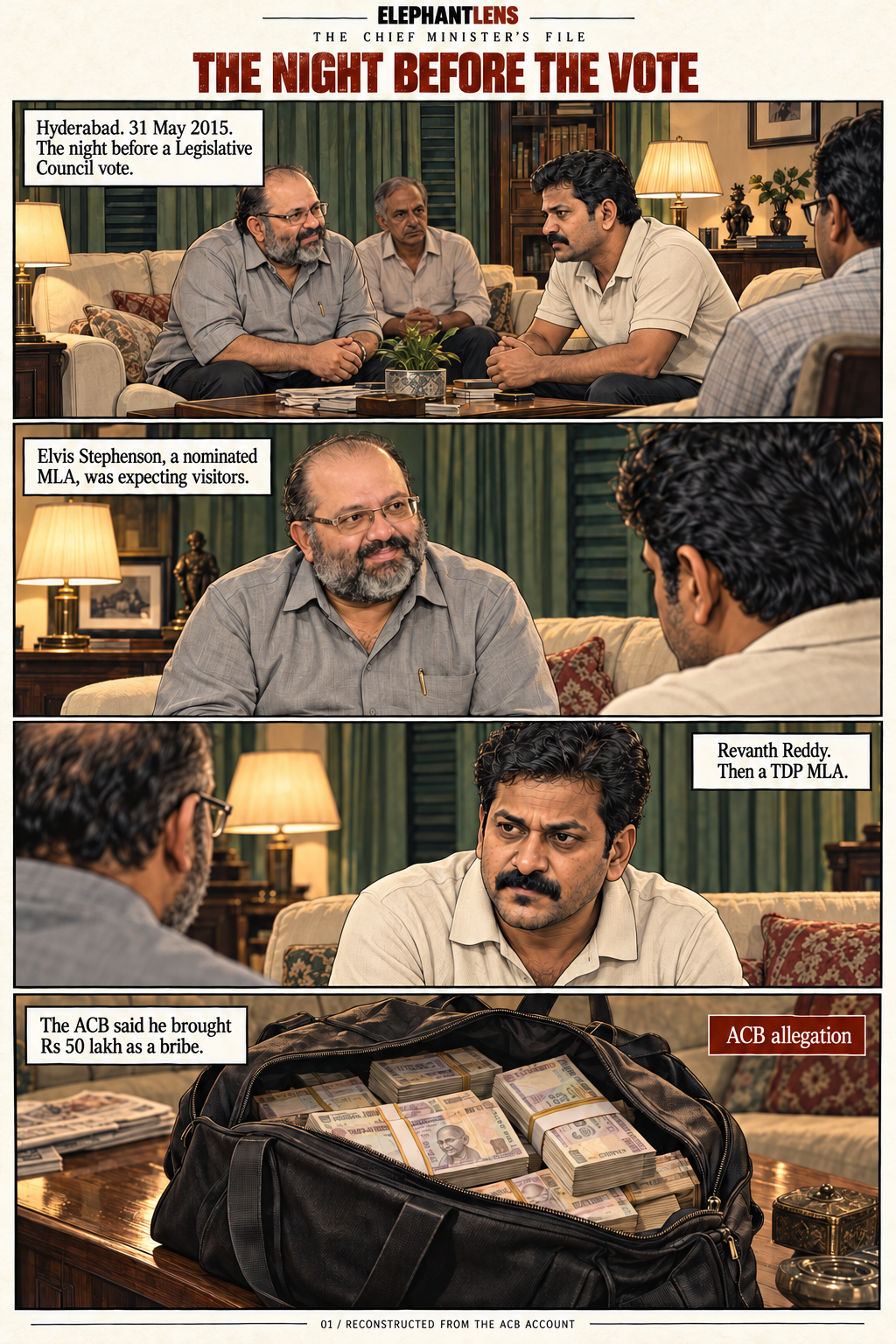
Historical scenes, rooms, police, officials, villagers and documents are illustrated reconstructions, not photographs or facsimiles. Public figures are drawn from visual references. Narration attributes disputed claims; no invented dialogue is placed in a real person's mouth. The Assembly remarks are paraphrased from reports.
What this edition draws on
This comic adapts the saved 11 October 2026 English edition of Elephant Lens record 62. The live article could not be retrieved during this work. Court and NHRC records and supporting reports were consulted where noted. This is not a complete audit of every allegation in the article or a confirmation of the latest status of every case.
The distinctions that matter
An allegation is not a finding. A complaint or notice begins a process; it does not prove the complaint. A court safeguard does not establish interference. A family or company connection does not prove a favour. An investment agreement is a proposal, not a payment. Removing one charge does not end all charges.
Reading order
Part One, pages 1-8: the tape and the prosecution. Part Two, pages 9-16: the land and the company questions. Part Three, pages 17-24: checking claims and questioning power. Cover and these notes are additional to the 24 story pages.
Art and continuity
Created with OpenAI image generation, using the final Jagan comic as the style reference and a dedicated Revanth character sheet. The younger and later portrayals retain the same face, with period-appropriate hair and clothing.
The Chief Minister's File
Revanth Reddy: the tape, the land, the questions · Free preview
Dramatised scenes explain the reporting. Allegations are not findings of guilt. Based on the saved reporting of 11 October 2026.
Read the scene transcript
Loading transcript…
About this
illustrated story.
SOURCES & PAGE NOTES
Pages 1-8 • The cash-for-vote case
The saved Elephant Lens article supplies the 2015 chronology and reported defence. The Supreme Court order of 20 September 2024 was read: it imposed safeguards but refused transfer and found no foundational basis for the apprehension presented. The comic preserves both points. No latest verdict or docket status is claimed.
Pages 9-13 • Lagacharla
The NHRC's 21 November 2024 release records the villagers' allegations, notices and proposed inquiry. Later findings, the acquisition changes and court stay are presented at report level, drawing on the saved article; the notice alone does not prove them. Locations and field boundaries are illustrative.
Pages 14-18 • Companies and the court record
Tesseract and Swachh are attributed to the saved article and reporting, including the government's replies. The KLSR recusal text and March 2026 operative decision were consulted from the local research archive. Ownership and a Chief Minister's role in the judicial approach are not established by those records.
Pages 19-22 • Journalists and detention
CPJ and The News Minute support the reported arrests, charge decision and Assembly remarks. The 2018 account draws on TNM and NDTV reports, including the police explanation and Election Commission action. These are distinct cases, not equivalent legal findings.
Pages 23-24 • Questions, not a verdict
Original fictional dialogue. Questions were prepared for the story; no outreach was sent. The ending invites scrutiny of public power without deciding criminal guilt.